How does a thermal form?
NARRATION: Almost all our planet’s heat is provided by the sun. If you’re looking to unlock the secrets of the weather, the heat coming from up there is not as important as when it’s coming from down there, from the ground. I know it sounds unlikely but it’s all to do with the fact that the sun heats the Earth unevenly. Sand gets hotter than water. Tarmac gets hotter than sand. Concrete gets hotter than grass. And these differences produce pockets of warm rising air called thermals, which drive winds and createclouds.
But how can you see that effect for yourself? Well, with a quarry, five vehicles’ worth of kit, and two specially built metal tables. These tables are going to be our hot ground. Because they’re dark in colour they should soak up lots of heat from the hot sun. And to make sure they get hot enough, we’re going to give the sun a little help.
TO CAMERA: To be perfectly clear, my ambition here is not to actually make weather with this. I’m not hoping for a little square cloud overhead. The theory’s right, it’s just the scale is a bit small. What I will be doing, is creating that rising column of air - that thermal - which is part of the weather, and it is something I will be able to show you once I’ve got it established.
NARRATION: So, let’s do all that, fire up the gas, and get me up above the tables so you can see the effects of our home-made thermal for yourself. Now, normally a paper helicopter would just spin slowly to the floor. But it doesn’t. It hovers.
TO CAMERA: Fly! Oh, there you go, there you go, there you go! You can see how we’ve created a thermal down there and the helicopters that catch it are flying in that column of rising air.
NARRATION: The updraft is enough to hold the helicopters in place. Just as they do naturally with clouds, raindrops and hailstones. But as the heat coming off the metal table increases the helicopters begin to climb…
TO CAMERA: Oh, yeah!
NARRATION: Until they’re disappearing out of sight, just like a real thermal. They can stretch up more than 1,500 metres - high enough to influence our weather.
Download/print a pdf of the video.
Richard Hammond demonstrates how thermals are formed through heat from the sun.
Our planet’s heat is provided by the sun, but our weather is often driven by heat radiated from the Earth’s surface. As the sun heats different surfaces and areas of the globe unevenly, weather results.
These differences create thermals which create clouds and pressure differences, leading to wind. An outdoor experiment in a quarry demonstrates how thermals are formed. Paper helicopters are used to show the rising air.
Teacher Notes
This short film provides useful background for KS3 / KS4 students studying how clouds form. A KS3 class could use their sense of touch (or surface thermometer) to explore the temperature difference between different surfaces around a school building.
Curriculum Notes
This topic appears in geography and physics at KS3 and KS4 in England, Wales and Northern Ireland and National 5 in Scotland. At GCSE it appears in AQA, OCR A, EDEXCEL, EDUQAS, WJEC and CCEA, in SQA at National 5.
More from Richard Hammond's Wild Weather
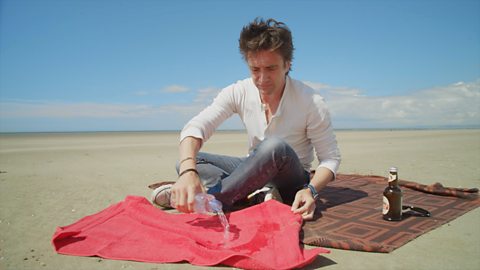
How can you cool a drink using the sun? video
Richard Hammond uses a beach, a towel, water and a drink to demonstrate how evaporation can be used to cool liquid.
How does hail form? video
Richard Hammond explores the weather conditions that form hail.
How to see thunder. video
Richard Hammond visits Lightning Testing and Consultancy in Oxfordshire to take part in laboratory experiments that demonstrate the effect of thunder within controlled conditions.
How to use wind to forecast the weather. video
Richard Hammond demonstrates how we can forecast the weather simply by watching the way the wind effects the clouds.
Inside a tornado. video
Richard Hammond explores the properties of a tornado that has been created in laboratory conditions.
What is the difference between rain and drizzle? video
Richard Hammond demonstrates a visual technique to distinguish between drizzle and rain.
What is wind? video
Richard Hammond demonstrates how wind is created due to differences in air pressure.
Why does water fall as rain? video
Richard Hammond demonstrates the effect of water on other physical objects.