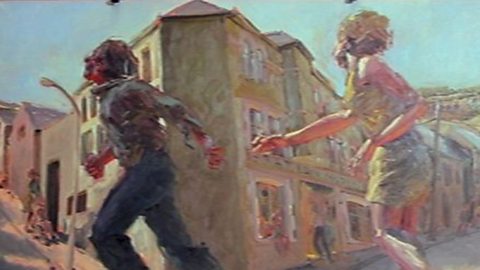
KIM HOWELLS: Josef Herman was celebrated in his own lifetime.
But another emigré artist was less well-known, but equally influential.
The German, Heinz Koppel, settled here in Dowlais, near Merthyr, in 1944.
Part of an artistic community, he taught local people and young artists.
His widow, Pip, remembers those tough early years.
PIP KOPPEL: He was eccentric, you'd call it now. We didn't use words like that then.
But he was a very approachable person. Not a jolly person, he was serious. If somebody wanted to work, he took them seriously.
And he was interested to see what people who came to paint chose to paint, to do.
He painted them, and they painted what they found and saw.
HOWELLS: Lots of young artists came to see him, because of course Heinz was an established painter.
Were they in awe of Heinz?
How did he greet them?
PIP KOPPEL: They never expressed awe. There was a very good relationship, but very clearly an appreciation of each other.
Rather than him up there and they down there.
HOWELLS: Heinz Koppel's effect on young artists in Wales wouldn't be seen for another decade.
But at the time, the Welsh arts establishment found him difficult.
Was he too much of a modernist for them?
PIP KOPPEL: No, I think the European element confused them, which came out and was too strange, too strong, at that time.
Video summary
A study of German artist Heinz Koppel, who settled in Merthyr Tydfil in 1944, in this KS3 video.
Kim Howells details Koppel's work and examines his eccentricity and approachability.
This clip is from the BBC Two series, Framing Wales.
Teacher Notes
Pupils could study the work of Koppel through the various paintings shown in the clip and by doing research on the internet.
They could discuss their responses to Koppel's art and choose one example to study in some detail.
From this contextual research, students could develop an imaginative, semi-abstract response to a similar subject. They can experiment with a variety of materials and select the most suitable to produce a final outcome.
Pupils can also produce a folded gallery guide for an exhibition of Koppel’s work.
This video is relevant for teaching KS3 Art and Design in England, Wales and Northern Ireland and third level in Scotland.
Terry Setch. video
Terry Setch talks to Kim Howells about using items washed up on the beach as a medium for his work.
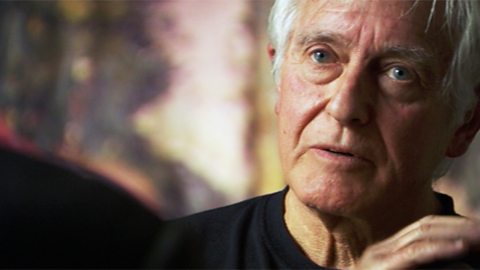
Ernest Zobole. video
The work of Ernest Zobole, a member of the Rhondda Group of artists whose colour palette was similar to European avant-garde artists.
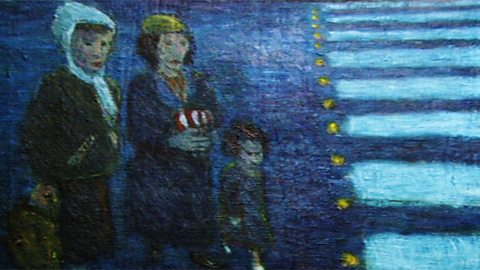
Evan Walters and The Jug. video
Presenter Kim Howells discusses Evan Walters' double-image painting Stout Man with a Jug, painted in the 1930s, with conservation officer Emma Benz Fisher.
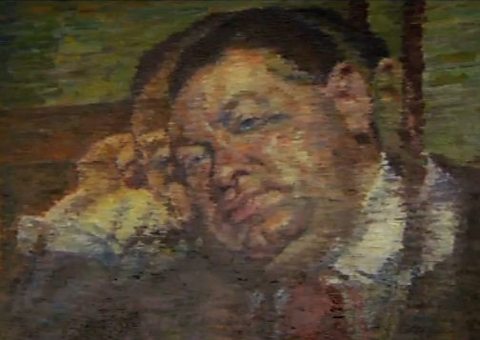
John Elwyn. video
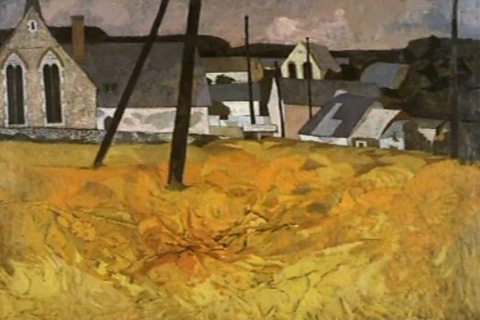
Landscape painter John Elwyn specialised in rural landscapes of south west Wales, despite living in England for a large part of his life.
Augustus and Gwen John. video
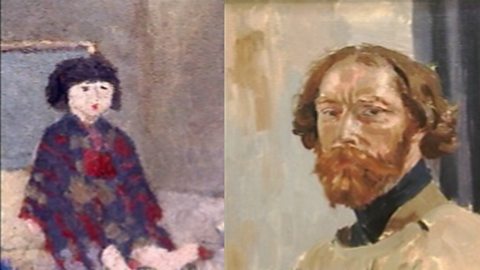
Tenby-born Augustus John and his sister Gwen had styles that were vastly different - developing their own take on the influence of European art movements.
Kevin Sinnott. video
Kevin Sinnott tells Kim Howells that his art reflects the community, life and passions of characters in the valleys and talks about his best known painting, Running Away with the Hairdresser.