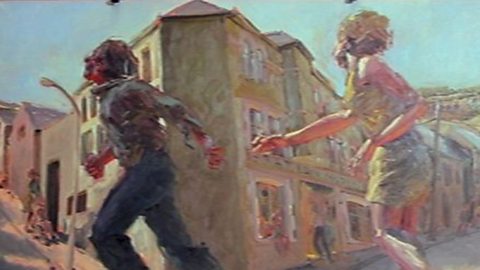
NARRATOR: Looking around in the realm of art, we encountered an artist who paints what he sees with both eyes.
Each of these overlapping images represents what the artist would see with one eye closed.
The reason of course is that we look at things with eyes that are in different positions.
Mr Evan Walters, the artist, demonstrates with an actual model.
He is painting exactly what he sees in relation to its background and the experiment will reproduce on canvas just what you would see if you held up your hand before your eyes and gazed at the wall beyond.
You would see two hands. Try it when you get home.
KIM HOWELLS: At the Glynn Vivian Art Gallery, conservation officer Emma Fisher is working on one of Walters' double image paintings.
Evan Walters started painting this double vision technique in the 1930s.
What was he trying to do, do you think, and how did he actually create this technique?
EMMA FISHER: The head looks like a very straightforward portrait almost.
But when you start looking around the painting you can see where he's repeated the hand and another eye too, so it gives an effect almost of movement.
It was possibly his response to the experimentation that was going on in art at the time.
KIM HOWELLS: So this was Evan Walters' stab at modernism?
EMMA FISHER: That's right, it possibly was.
KIM HOWELLS: How do you set about cleaning something as precious as this?
EMMA FISHER: First of all you make an assessment of the condition of the painting, to make sure it's safe to start cleaning.
What we use is a cotton wool swab and some saliva. I roll it very gently over the painting.
The enzymes in saliva are very good at removing dirt.
If it was in somebody's home and they were smokers then you do find that lots of tobacco's built up on the painting.
If you see, there's quite a bit of dirt there already.
KIM HOWELLS: You have to be careful you don't put that back in your mouth, do you?
EMMA FISHER: That's right, you wouldn't want to put it back in again, yeah.
Video summary
Presenter Kim Howells interviews conservation officer Emma Benz Fisher about Evan Walters' double-image painting Stout Man with a Jug, painted in the 1930s. Parts of the image are repeated to give the effect of movement. She also shows one simple step in cleaning old paintings - using a cotton bud and a little saliva in this KS3 video.
This clip is from the BBC Two series, Framing Wales.
Teacher Notes
Pupils can explore simple visual tricks or effects like double vision and try to convey these in sketches, drawings and paintings - explore and experiment!
Pupils could also discuss how 3D films appear without the special spectacles provided and link this to examples of the multi-viewpoint works by Picasso, cubists, and pointillists such as Seurat.
Enlist the expertise of a Human Biology teacher to explain how the human eye works.
From the different examples studied, produce a class assemblage on the theme of Looking and Seeing.
This video is relevant for teaching KS3 Art and Design in England, Wales and Northern Ireland and third level in Scotland.
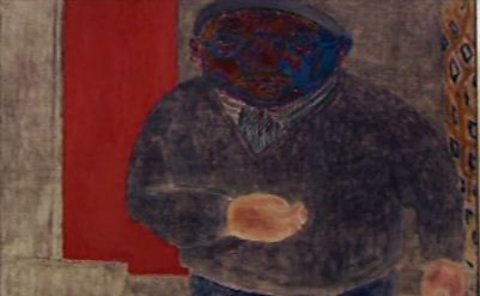
Heinz Koppel. video
A video showing the work of German artist Heinz Koppel, who settled in Merthyr Tydfil in 1944.
Terry Setch. video
Terry Setch talks to Kim Howells about using items washed up on the beach as a medium for his work.
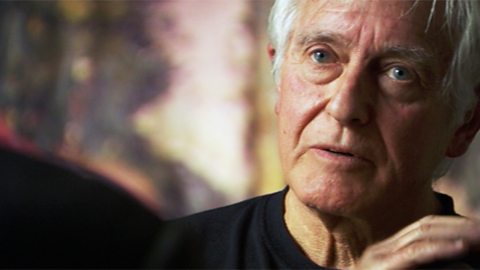
Ernest Zobole. video
The work of Ernest Zobole, a member of the Rhondda Group of artists whose colour palette was similar to European avant-garde artists.
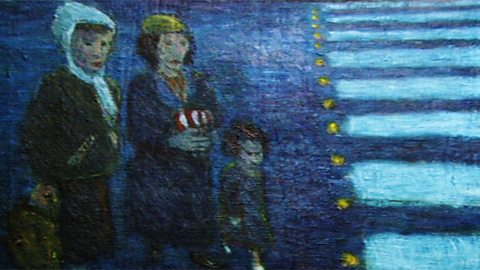
John Elwyn. video
Landscape painter John Elwyn specialised in rural landscapes of south west Wales, despite living in England for a large part of his life.
Augustus and Gwen John. video
Tenby-born Augustus John and his sister Gwen had styles that were vastly different - developing their own take on the influence of European art movements.
Kevin Sinnott. video
Kevin Sinnott tells Kim Howells that his art reflects the community, life and passions of characters in the valleys and talks about his best known painting, Running Away with the Hairdresser.