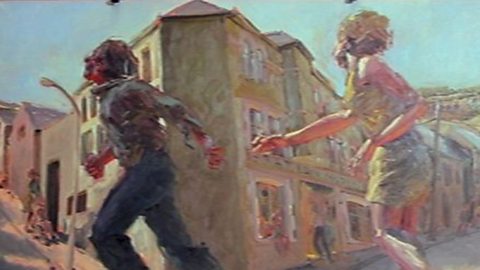
KIM HOWELLS: The University of Glamorgan in Pontypridd has a fine collection of Ernest Zobole's work.
Art historian Ceri Thomas, whose father Robert was also a key member of the Rhondda Group, is an expert on Zobole.
Ernie Zobole, very early on, even when he was still an art student, was painting in colours which looked like very, very avant-garde European painters.
Where would he have seen this kind of work?
CERI THOMAS: Very early on, they were travelling to London and looking at the latest exhibitions.
So Van Gogh, you know, the explosion of colour that was Van Gogh, was known to Zobole.
But closer to home, I think it really was Ceri Richards. In these pictures, in the early Fifties, he's limiting his palette to a blue.
And Richards had experimented with that same kind of palette himself, looking back at people like Matisse, in a series of paintings of Trafalgar Square.
So we have Zobole then looking at the squares and the streets in the Rhondda, and introducing this blue, as you say, avant-garde palette.
KIM HOWELLS: As his career progressed, Ernest Zobole's paintings became more stylised, transforming the Rhondda into an abstract and simplified universe.
In the final years before his death in 1999, Ernest Zobole created a unique image of his native valley, often seen at night, and full of jewel-like colours.
ERNEST ZOBOLE FOOTAGE: When I have spoken about getting different angles, different shots, different viewpoints into the same picture, getting in more than one could see, as it were, from one viewpoint.
This night-time thing helps in doing that, because looking round now, you can see objects illuminated, and they crop up at different levels of a black curtain, as it were.
KIM HOWELLS: Ceri, this is the mid-1990s, and this is one of Ernie Zobole's last paintings.
It's about a man who knows he hasn't got much longer to live. It's a very beautiful painting.
CERI THOMAS: The right hand side of the painting is more abstract.
But certainly, the left-hand side, you know, the figure returns and he actually is painting himself here, in this curious rectangle.
Some people see the rectangle not as a mirror, not as a doorway, but as a coffin.
So, I think there is that kind of resonance.
Certainly in his mind's eye, he is moving away into another place.
And the whole kind of Rhondda is almost becoming an encapsulated bubble.
And we have this 360 degrees of sky round the edge.
Art historian Ceri Thomas discusses the work of Ernest Zobole, a member of the Rhondda Group of artists whose colour palette was similar to avant-garde artists in Europe in this KS3 video.
This clip is from the BBC Two series, Framing Wales.
Teacher Notes
Students could discuss the work of Zobole in groups. They could create a sketch of a townscape near them in pencil or charcoal and experiment with viewpoints and perspective.
Using a limited palette, students could create an image of a town or landscape at night choosing the paint colours with care to create a different atmosphere.
Students could write a tribute to the work of Ernest Zobole, describing a few of his paintings and giving a personal view of what is thought about them.
Curriculum Notes
This video is relevant for teaching KS3 Art and Design in England, Wales and Northern Ireland and second level in Scotland.

More video clips on Welsh artists:
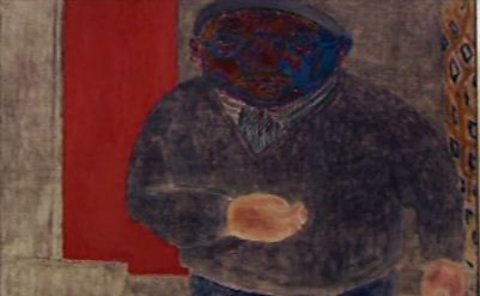
Heinz Koppel. video
A video showing the work of German artist Heinz Koppel, who settled in Merthyr Tydfil in 1944.
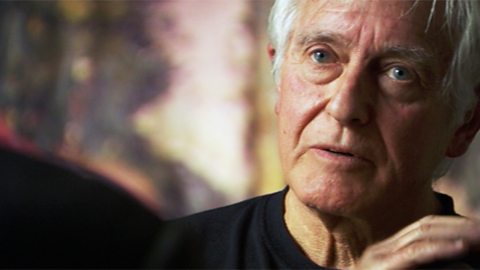
Terry Setch. video
Terry Setch talks to Kim Howells about using items washed up on the beach as a medium for his work.
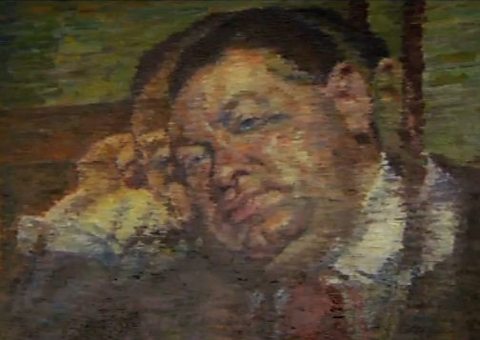
Evan Walters and The Jug. video
Presenter Kim Howells discusses Evan Walters' double-image painting Stout Man with a Jug, painted in the 1930s, with conservation officer Emma Benz Fisher.
John Elwyn. video
Landscape painter John Elwyn specialised in rural landscapes of south west Wales, despite living in England for a large part of his life.
Augustus and Gwen John. video
Tenby-born Augustus John and his sister Gwen had styles that were vastly different - developing their own take on the influence of European art movements.
Kevin Sinnott. video
Kevin Sinnott tells Kim Howells that his art reflects the community, life and passions of characters in the valleys and talks about his best known painting, Running Away with the Hairdresser.