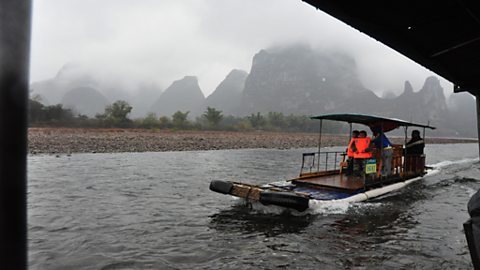
A child-led introduction to Yangshuo in Guangxi Province, China, suitable to support study of a location in Asia at KS3.
The video
KS3 Geography. Life in China
Yangshuo
MA SIDUO: My name is Ma Siduo. I am nine years old. I live in Yangshuo.
NARRATOR: Yangshuo is part of Guangxi Province in Southern China. It is a spectacular area, very popular with tourists drawn here by the sights of the amazing karst landscape. At the bottom of the valleys flow the rivers Yulong and Li. Temperatures are generally warm but it can get very wet and foggy in the rainy season.
SIDUO (TRANSLATED): [DESCRIBING HER DRAWINGS] I really like drawing the landscapes here. These are the hills of Yangshuo. This is the River Li, which is next to my home. This is a bamboo raft. This is a fisherman. This is the fisherman’s cormorant. This is the famous Moon Hill.
NARRATOR: The whole area where Siduo lives is on a bed of limestone rock. It’s the limestone that forms the steep-sided mountains - or ‘karsts’ - and the underground caves. Limestone is a porous rock and alkaline so when the slightly acidic rain falls - as it does in the rainy season, like now - the rock dissolves forming impressive stalactites and stalagmites in the caves. A whole tourist industry has built up in Yangshuo. There are lots of hotels and restaurants and bustling street markets where farmers and local craftsmen can sell their goods.
SIDUO (TRANSLATED): Many tourists come to visit Yangshuo. They really like our local products.
I like wandering through the town with my friends. I have lots of good friends.
The beautiful fans are very popular; we like choosing our favourites. All these fans are made in Yangshuo county.
We like star fruit. Everyone gets a piece.
Here you can stop and see how silk is made. We like playing with the silk worms…but I think they’re a bit scary!
SIDUO (TRANSLATED): Lots of people like to stop and buy snacks. This is tofu with chives, chilli, beans and a sweet sauce. It’s really tasty.
NARRATOR: School and after school clubs are a very big part of Chinese children’s lives.
SIDUO (TRANSLATED): I go to school every day at seven thirty. My Mum takes me on her electric scooter. My Mum works as a teacher at my school…so we can travel together every day.
We all have breakfast at school. We usually have Guilin rice noodles. They’re mixed with soya bean, spring onion, pork and chilli. People here like eating spicy food!
The first lesson today is Maths. First of all, the whole class stands up and bows to the teacher. This is part of Chinese etiquette, and is to pay respect to our teacher.
NARRATOR: The children learn about the history of maths reading it out loud as a class before they start their sums.
[THE CLASS CHANT TOGETHER]
SIDUO (TRANSLATED): Mrs Yang is our Maths teacher. After the first class we do exercises in the playground. Our leader is my friend Xu Shichen.
NARRATOR: The children exercise to keep warm as there is very little heating - if any - in the school buildings.
SIDUO (TRANSLATED): Every Friday evening I have my favourite class - dancing. My friend Xu Shichen is my dance partner. We’ve been dancing together since we were six. We’ve done competitions together. I really like dancing, because when I dance it makes me really happy.
NARRATOR: Siduo loves her friends and her school and her hometown of Yangshuo. She is lucky enough to live in one of the most beautiful parts of China.
Download/print a transcript of the video.
A child-led introduction to Yangshuo in Guangxi Province, China - an area famous for the karst limestone peaks and limestone caves.
The town lies on the Li River and local farmers come to the market on their bamboo rafts, ferry boats, tractors and lorries to sell their citrus fruit and vegetables, which are grown abundantly in this province where the climate is hot and humid in the summer and cold, foggy and wet in the winter.
Tourism is the main business here and many visit the area to see the karst peaks and to buy the Chinese fans and silks associated with the area.
Ma Siduo is 10 years old, her mother is a teacher at her school and they travel together every morning on her Mum’s scooter. The school day starts with reading and exercises in the playground to keep warm.
She likes to go into town with her friends to look at the silk worms, Chinese fans and to eat the local food and fruits, especially star fruit and other local delicacies like spicy tofu.
Ma Siduo loves to dance and has won many dance competitions with her friend and partner Xu Shichen. We also visit the limestone caves nearby and look at Moon Rock, a mountain with a moon shaped hole through it.
This clip was originally broadcast as part of the series In My Shoes.
Teacher Notes
Download/print the Teacher Notes for this episode (pdf).
Teacher Notes prepared in partnership with the Geographical Association.
Before watching the video
- Using a map locate Yangshuo. Zoom in and look at the terrain. How does it differ to the landscape students can see outside of their own window?
- Ask students what they think it would be like to live in this location. How does it differ from where they live? Students could create a list of their predictions.
- Introduce key terms such as:
Karst: a landscape formed by the dissolution of soluble rocks, like limestone.
Stalactite: a mineral formation, often resembling an icicle, that hangs from the ceiling of a cave.
Stalagmite: an upward-growing mound of mineral deposits that have precipitated from water dripping onto the floor of a cave.
While watching
You may wish to stop at relevant points during this short film to pose questions and check understanding or wait until the end. Useful questions might include:
- Describe the landscape that you can see. What is it like?
- What is the climate like in this location?
- What is a karst landscape?
- Why would tourists want to visit this location?
- What types of food do people like to eat?
- Why is education important to these children?
After watching
- Ask students to look back at their predictions. Were they correct in what they thought life would be like if they lived in Yangshuo?
- Look at images of the karst landscape. This is a great opportunity to practice field sketches, much like Ma Siduo did in the film. Students can annotate their field sketches to show the different limestone features that they can see. Ask students how they think those landscapes formed and whether there is anything similar in the UK.
- Students could carry out further investigations into Yangshuo. How does the weather and climate change throughout the year? What types of food do they like to eat? What do tourists visit when they go to Yangshuo?
Where next?
- Using the Dollar Street website investigate the lives of other families around the world. This website gives you an insight into their lives and looks at different products that families have in their homes.
- Students could use this information to make a comparison to Ma Siduo’s life and also to their own. Students could put this information into a table to enable them to make clear comparisons.
Links
Introduction to China:
https://www.bbc.co.uk/bitesize/articles/zk9h6g8
How is China changing?
https://www.bbc.co.uk/bitesize/articles/zt6cg7h
Limestone landscapes:
https://www.bbc.co.uk/bitesize/guides/zvp82hv/revision/5
Curriculum Notes
This clip will be relevant for teaching Geography at Key Stage 3 in England and Northern Ireland, 3rd Level in Scotland and Progression Step 4 in Wales. The National Curriculum for Geography at KS3 requires the study of a location in Asia, 'including China’.
Students and teachers over the age of 16 can create a free Financial Times account. For a Financial Times article about life in China from 2018, click here.
More from Life in China:
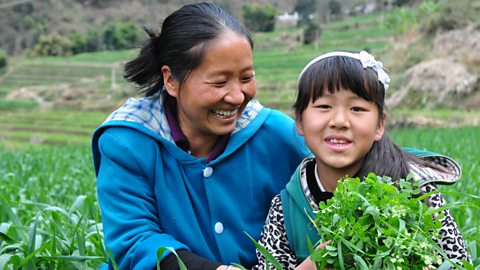
Life in China - Chan’gou video
A child-led introduction to Chan’gou in Yunnan Province, China.
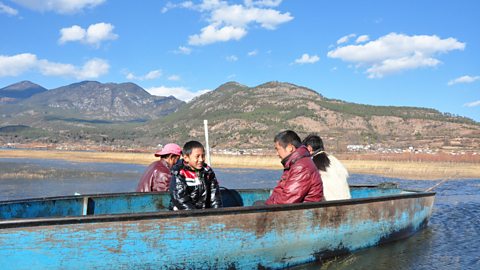
Life in China - Lijiang. video
A child-led introduction to Lijiang in Yunnan Province, China.
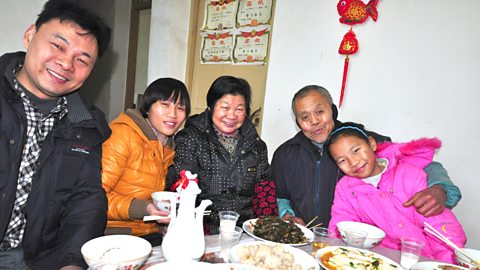
Life in China - Sandouping. video
A child-led introduction to Sandouping in Hubei province, China.
Life in China - Shanghai. video
A child-led introduction to the city of Shanghai in China.
Life in China - Xingping. video
A child-led tour of Xingping in Guangxi Province in China.