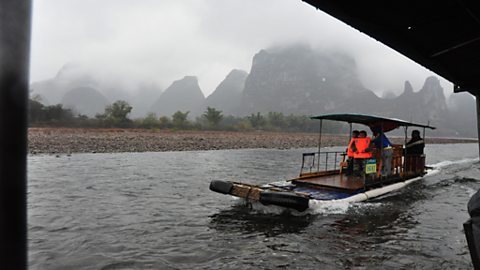
A child-led introduction to Chan’gou in Yunnan Province, China, suitable to support study of a location in Asia at KS3.
The video
KS3 Geography. Life in China
Chan’gou
RUIQIN: Hu Ruiqin. I am ten years old.
NARRATOR: Ruiqin and her family live in a small village in a mountain valley in the Jijiang district of Yunnan Province. Her village is called Chan’gou. It’s a very beautiful place in a mountainous and remote part of China.
The landscape is covered with terracing to provide patches of flat farming land cut into the steep slopes. This ingenious method of farming allows people to grow a whole range of crops like rice corn barley wheat and sweet potatoes.
RUIQIN (TRANSLATED): You have to take a windy, narrow mountain road to get to Chan’gou village. We have two busses a day between our village and Lijiang. It takes three hours to get here from Lijang. My school is Jinjiang Primary School. It’s the only one in Chan’gou. It has 78 pupils. Children come here from the age of five to eleven. Our school motto is, ‘Education achieves your future. Knowledge changes your fate’.
Some kids sleep at school - like me - and some go home. There are six people in my class. Today is the day of our Maths exam. I find Maths quite hard. I prefer Chinese. We’re breaking up for our winter holiday and it’s also our Spring Festival.
NARRATOR: The teacher sends the children on their way with instructions to do their homework and respect their parents, but also with a word of warning about fire. There are always lots of fireworks around at festival time.
RUIQIN (TRANSLATED): This is my dormitory. There are eight of us living here. The younger ones sleep on bottom beds, and the older girls on the top. My dad is fetching me and my little cousin. We take all our bedding home, so it gets washed.
NARRATOR: The journey between school and home is often too far to walk every day, which is why so many children board during term times. There are no buses, so walking is the only way.
NARRATOR: The route is rugged and tiring, especially when you have to carry everything. But the views along the way are stunning.
RUIQIN (TRANSLATED): There are lots of small rivers around my house. So you always hear the sound of flowing water. The most famous river near my house is called the Jinsha river.
NARRATOR: The Jinsha River is deep and wide. It’s a headwater stream of the famous Yangzte and winds its way south through a deep gorge. Jinsha actually means golden sands. Over the years gold deposits have been found along its banks.
The ferryboat is a lifeline for people living in the remote villages along the riverbank. Without it they wouldn’t be able to buy or sell goods, or even see a doctor if they were sick.
The trails and tracks of the rugged terrain are heavy going. Mules and horses are still the best way to get around.
RUIQIN (TRANSLATED): I am really happy to be home because I can be with my mum, my little sister and my dad again.
NARRATOR: After a long journey home everyone is hungry. Almost everything Ruiqin’s family eats is home-grown.
RUIQIN (TRANSLATED): These are chillis that we grow ourselves. These dry corn on the cobs are for feeding the pigs. These are dried peas. We dry them on a bed of straw.
Over there are our pumpkins. Sometimes we cook the pumpkins with goat meat or pork. It’s really tasty.
Yunnan dishes are well known for their flavour. This is a radish. We’ll cook it for lunch. When I’m home I help my parents with cooking. All our water is spring water from the mountains, and all our food is home grown. Mum often teaches me how to cook.
We’re cooking homemade bacon, rice and lots of different vegetables. I love eating at home because mum and dad’s cooking is really delicious.
This is my baby sister. Her name is Shiqi. She’s only five months old. It will be nice to play with her in my break.
NARRATOR: Like most people in the mountains, Ruiqin’s family are subsistence farmers. They grow only what they need to eat well and the chances are that everything they have is grown within a five-mile radius.
RUIQIN (TRANSLATED): Here we grow potatoes, potatoes, potatoes, and barley. Now we have to weed regularly, so that the wheat can grow tall and healthy. I really love it when the crops and scenery are all green.
NARRATOR: Life can be hard here. Travelling any distance is tricky and growing enough to eat requires skill and perseverance. But communities here are close and supportive of each other. It’s a healthy and simple life but Ruiqin and her family love living in such a remote, mountainous area.
Download/print a transcript of the video.
A child-led introduction to Chan’gou in Yunnan Province, China.
He Ruiqin lives in a remote mountain village about three hours from the ancient city of Lijiang.
Her parents are subsistence farmers, making a living from the crops of wheat, potatoes and barley grown on the steep terrace slopes surrounding their house.
During term time Ruiqin and her friends all board at school because the journey is too long to travel everyday and their parents work so hard and spend long hours in the fields tending their crops.
The area is famous for its fast-running rivers and deep gorges. Local people travel across the rivers by boat so that they can trade their produce.
At home with her family she helps in the fields and spends time with her baby sister. They grow their own food and love to eat the traditional spicy food associated with this region of China.
This clip was originally broadcast as part of the series In My Shoes.
Teacher Notes
Download/print the Teacher Notes for this episode (pdf).
Teacher Notes prepared in partnership with the Geographical Association.
Before watching the video
- Using a map locate Chan’gou. Zoom in and look at the terrain.
- Ask students what they think it would be like to live in this location. How does it differ from where they live? Students could create a list of their predictions.
- Introduce key terms such as:
Terracing: a sloping piece of land that has had flat areas like steps built on it.
Gorge: a steep sided narrow valley.
Subsistence farmers: farming to grow food for yourself and your family.
While watching
You may wish to stop at relevant points during this short film to pose questions and check understanding, or wait until the end. Useful questions might include:
- Describe the landscape. What is it like?
- Why do some of the children sleep at the school?
- Why is the ferryboat needed?
- Why do people grow a lot of food for themselves?
- What could make life quite challenging in the mountains?
After watching
- Ask students to look back at their list of predictions. Discuss whether they were correct. What else did their find out about life in this region? Were there any similarities or differences between Ruiqin’s life and the life of the students in your class.
- Discuss with students whether they think this the life of a typical child in China. Maps could be used to look at other areas of China. This will help students to avoid a single-story narrative of a country as they will see that life can differ within a country and that China had a range of different landscapes as you move across this very large country.
- Students could further investigate the food that Ruiqin was eating. What are the typical dishes that people in Chan’gou eat? What do the foods tell us about that area? Students could compare this to the other children in this series.
- Show the students a climate graph for this region. How does the weather change throughout the year? What impact might this have on the children?
Where next?
- Using the Dollar Street website investigate the lives of other families around the world. This website gives you an insight into their lives and looks at different products that families have in their homes.
- Students could use this information to make a comparison to Ruiqin’s life and also to their own. Students could put this information into a table to enable them to make clear comparisons.
Links
Introduction to China:
https://www.bbc.co.uk/bitesize/articles/zk9h6g8
How is China changing?
https://www.bbc.co.uk/bitesize/articles/zt6cg7h#zph896f
Curriculum Notes
This clip will be relevant for teaching Geography at Key Stage 3 in England and Northern Ireland, 3rd Level in Scotland and Progression Step 4 in Wales. The National Curriculum for Geography at KS3 requires the study of a location in Asia, 'including China’.
More from Life in China:
Life in China - Lijiang. video
A child-led introduction to Lijiang in Yunnan Province, China.
Life in China - Sandouping. video
A child-led introduction to Sandouping in Hubei province, China.
Life in China - Shanghai. video
A child-led introduction to the city of Shanghai in China.
Life in China - Yangshuo. video
A child-led introduction to Yangshuo in Guangxi Province, China.
Life in China - Xingping. video
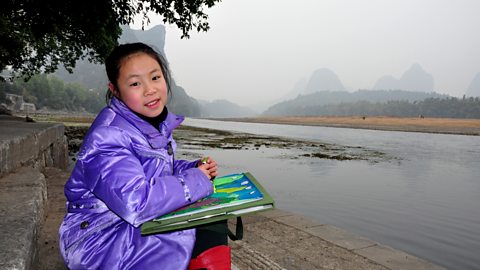
A child-led tour of Xingping in Guangxi Province in China.