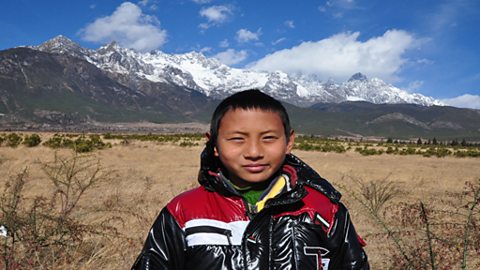
A child-led introduction to Xingping in Guangxi Province, China, suitable to support study of a location in Asia at KS3.
The video
KS3 Geography. Life in China
Xingping
JIA DENG HUI: My name is Jia Deng Hui. I am nine years old.
TRANSLATED: This is my friend Fung Ju Lin. He’s my best friend. We live on an island near Xingping.
Xingping is in Guangxi Province in south China. This area is very famous for the Karst Peak mountains and Li River.
The Li River is 440 kilometres long. When it rains it’s hard to see how beautiful the landscape is. But visitors still come here to admire the views. Even though it’s winter.
Here is the famous view on our 20 yuan note. If you come to China you will use a 20 yuan note. And then you’ll know the picture of those mountains is where I live. This rocks says ‘20 yuan note view’.
My mum sells fruit here. It’s really hard to sell fruit right now because it’s raining a lot and very cold. We grow lots of fruit on the island where I live. My mum has her own orange trees.
[THEY TALK IN MANDARIN]
She explains lots of things to my friends and I. She says the best time for oranges is December to January. We have four different kinds of oranges. Some are sweeter than others. We all eat a lot of fruit. My mum says if you throw away the bad ones the good ones have more chance to grow.
I like oranges but my favourite is pomelo. There are lots of pomelos on our island. They’ve all been picked now so they get taken off to the markets. Nearly every day you can see them loaded onto boats.
I have breakfast by the fire at 7:30. My mum usually makes me rice with meat.
At eight o’clock every morning I leave home. My house is really close to the river so it only takes a minute to get there.
My dad is really good at fixing boats. This is how he earns money.
My friend Fung Ju Lin and I always go to school together. All the children on our island have to cross the river to get to school.
From the harbour we walk the rest of the way. Classes start at 8:40.
If you come to Xingping you have to take a river trip. My friends and I live here so we just play around on boats. The temperature is really cold now. Our lifejackets help to keep the wind and rain out.
It’s very cold for the fishermen too. Winter is not a good season for catching fish because there are hardly any fish in the river in the winter. Some of the fishermen use cormorant birds to help them fish.
Lots of the views were painted by Chinese painters. And written about by many poets. One poem is by a famous Chinese poet called Han Yu: The river winds like a green silk ribbon while the hills are like jade hairpins.
But you should come when it’s warmer to see the famous views.
Download/print a transcript of the video.
Jia Deng Hui lives on a little island in the Li River.
If they need to go anywhere, the inhabitants must use a boat to cross the river onto the mainland - even school requires a boat journey every day.
He spends all his free time with his friend.
They show us the beautiful karst peaks and life on the banks of the Li River.
Despite the fog, common at this time of year, we can see the busy river traffic framed by the spectacular peaks.
The 20-Yuan note depicts the view in his locality and he excitedly shows us the 'real life' view.
His mother works hard selling fruit to tourists and workers.
She grows her own citrus fruit, including oranges and pomelo, and she teaches the boys how to take care of the citrus trees so that they yield the best fruit.
Teacher Notes
Download/print the Teacher Notes for this episode (pdf).
Teacher Notes prepared in partnership with the Geographical Association.
Before watching the video
- Using a map locate the Li River. Zoom in and look at the terrain. How does it differ to the terrain they can see outside of their classroom window?
- Ask students what they think it would be like to live along this river. How does it differ from where they live? Students could create a list of their predictions.
- Introduce key terms such as:
Yuan: the currency in China.
Karst: a landscape formed by the dissolution of soluble rocks, like limestone.
While watching
You may wish to stop at relevant points during this short film to pose questions and check understanding, or wait until the end. Useful questions might include:
- Describe the landscape that you can see. What is it like?
- Why might tourists visit this location?
- What is the climate like in this location?
- Why do the children need to get a boat to school?
- What types of jobs do people do here?
After watching
- Ask students to look back at their predictions. Were they correct in what they thought life would be like if they lived along the Li River.
- Students could consider the similarities and differences between their own town and the remote mountain village of Xingping, China, by presenting this information in a Venn diagram.
- Using the film as a stimulus, pupils could complete further research on the Li River and Xingping and subsequently write a report about the settlements, methods of transport, self-sustainable lifestyle and the influence of tourism shown in the clip.
- Show the students a climate graph for this region. How does the weather change throughout the year? What impact might this have on the children? How does it differ to what is seen in the film?
Where next?
- Using the Dollar Street website investigate the lives of other families around the world. This website gives you an insight into their lives and looks at different products that families have in their homes.
- Students could use this information to make a comparison to Jia Deng Hui’s life and also to their own. Students could put this information into a table to enable them to make clear comparisons.
Links
Introduction to China:
https://www.bbc.co.uk/bitesize/articles/zk9h6g8
How is China changing?
https://www.bbc.co.uk/bitesize/articles/zt6cg7h
Curriculum Notes
This clip will be relevant for teaching Geography at Key Stage 3 in England and Northern Ireland, 3rd Level in Scotland and Progression Step 4 in Wales. The National Curriculum for Geography at KS3 requires the study of a location in Asia, 'including China’.
More from Life in China:
A child-led tour of Shanghai in China. video
A child-led introduction to (and tour of) the Chinese city of Shanghai.
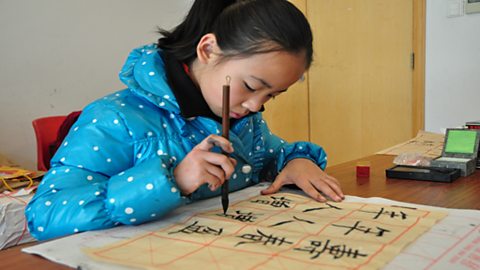
A child-led tour of Yangshuo, in China. video
A child-led tour of Yangshuo, in China.
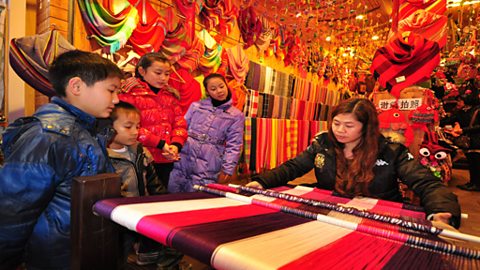
A child-led tour of Chan'gou in the Yunnan Province of China. video
The physical and human geography of Chan'gou, Yunnan, China.
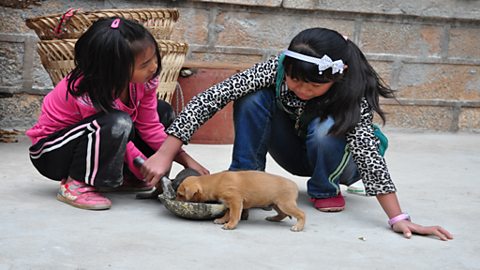
A child-led tour around Sandouping, in China. video
A child-led tour of Sandouping in Hubei province, China.
A child-led tour of Lijiang, in China. video
A child-led introduction to Lijiang in Yunnan Province, China.