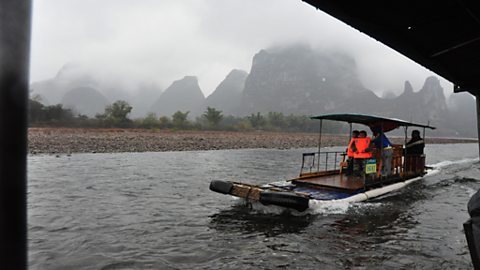
A child-led introduction to Lijiang in Yunnan Province, China, suitable to support study of a location in Asia at KS3.
The video
KS3 Geography. Life in China
Lijiang
WANG YUXI: My name is Wang Yuxi. I am 11 years old. I live in Lijiang.
NARRATOR: Lijiang is located in the province of Yunnan, in the southwest of China. It’s one of China’s most famous ancient cities and home to over a million people.
The area around Lijiang is where the Naxi people come from. ‘Na’ means ‘senior and honoured’ and ‘Xi’ means ‘people’. Wang Yuxi’s family are Naxi.
WANG YUXI: My Dad’s a driver. Sometimes he takes me out on trips. I love going out on trips together with my Dad. He knows all the best places to go.
NARRATOR: First stop for Yuxi and his dad is the famous Jade Snow Dragon Mountain on the outskirts of the city of Lijiang.
WANG YUXI: Everyone who lives near the Jade Snow Dragon Mountain believes that it is sacred.
NARRATOR: These mountains give the people water, wood and some natural medicines. Scientists come from all over the world to study the rare plants and animals found here. The peaks are covered in snow all year round and are home to the southernmost glacier in the northern hemisphere.
Not far from these beautiful mountains is Lake Lashihai.
WANG YUXI: This lake is the largest in Lijiang county. The local fishermen fish here, and lots of tourists like to visit. There are loads of fish in this lake; most of them are grass carp. If you take a boat out, you can try some of these fish. A fisherman will grill you some fish. Although the fish has many bones, it’s really tasty! It makes me laugh when the fishermen ask the tourists [IN ENGLISH] ‘Like a fish?’
NARRATOR: The lake is also a good place for birdwatching.
WANG YUXI: Many birds spend the winter here, then leave in the spring.
NARRATOR: Yuxi and his father visit the ancient tea route which begins near the lake. More than 1,000 years ago the locals started using these special horses to carry the tea grown in the fields of Yunnan. The mountain tracks of the tea route - or ‘Silk Road’ as it’s also known - were the best way to transport not only tea but also sugar and salt for trading.
Traders visited neighbouring provinces like Tibet and Guizhou to sell their goods. But some of traders would trek for hundreds of miles through mountains and forests until they reached the markets of neighbouring countries Burma, Laos and Vietnam.
Yunnan has great conditions for growing tea: fertile soil, lots of rain, never blisteringly hot, and never freezing cold.
Yunnan tea has a very special flavour and is enjoyed all over the world. Yuxi and his dad went to a local teahouse to try it for themselves.
WANG YUXI: The lady showed me how the horses used to carry the tea. The leaves were squashed into a ‘tea brick’, and then put into bamboo boxes to protect them from the rain. The most famous Yunnan tea is called ‘Pu’er’ tea. The tea trail area is home to many Naxi people.
NARRATOR: Naxi families like Yuxi’s are very close-knit, which probably helps them to keep their traditions alive.
WANG YUXI: My family is Naxi. My Grandmother still wears Naxi costume every day. Her costume has seven stars on it. They represent the seven stars of the ‘Big Dipper’. Naxi women are extremely hard working. They work from first light into the evening.
NARRATOR: Yuxi is off to find his best friend.
WANG YUXI: My friend is called Wang Jincheng. We’re in the same class together and our Dads are good friends. He lives nearby.
This is some Naxi writing. This one means to talk. This one means to dance. This one means to eat.
The yoghurt from this shop is very famous. It’s very popular with the tourists. The sweet red beans that you can mix with the yoghurt are really delicious!
NARRATOR: A local Naxi wedding is taking place in Lijiang Old Town.
[SINGING AND MUSIC]
WANG YUXI: Singing and dancing are important in Naxi culture.
NARRATOR: Yuxi’s hometown of Lijiang really is a beautiful and unique place. And it’s no surprise that so many people come here from all over the world to visit.
Download/print a transcript of the video.
A child-led introduction to Lijiang in Yunnan Province, China.
Wang Yuxi is a Naxi boy. The Naxi are one of the 25 minority groups that live in Yunnan. They are ancient peoples, indigenous to this part of China.
Lijiang is situated in the shadow of the foothills of the Himalayas and its spectacular landscapes and ancient architecture are a magnet for tourists.
Wang Yuxi’s father is a driver for the many tourists, while his grandmother - who still wears traditional Naxi dress - does most of the work at home.
He takes his son on a tour of the locality. They fish for grass carp on the beautiful Lake Lashihai and take in views of the Yulong mountains, especially Jade Dragon Snow Mountain.
The area is famous for Chinese herbs used in traditional medicine and for tea.
They ride ponies along the ancient tea trail - the route runs into neighbouring Myanmar - formerly Burma - Laos, and Vietnam. NB: the map which features near the start of the video clip uses the name 'Burma'. The military government of Burma changed the name of the country to 'Myanmar'. However, use of the name 'Burma' remains widespread and it is the policy of the UK government to use that name, as it is also adopted by the country's democracy movement.
With his friend he runs through the ancient alleyways of the old town to get to a Naxi wedding on time.
This clip was originally broadcast as part of the series In My Shoes.
Teacher Notes
Download/print the Teacher Notes for this episode (pdf).
Teacher Notes prepared in partnership with the Geographical Association.
Before watching the video
- Using a map locate Lijiang. Zoom in and look at the terrain. How does it differ to the terrain they can see outside of their classroom window?
- Ask students what they think it would be like to live in this location. How does it differ from where they live? Students could create a list of their predictions.
- Introduce key terms such as:
Glacier: a slow-moving river of ice.
Trading: the exchange of goods between countries.
Province: an area of land within a country.
While watching
You may wish to stop at relevant points during this short film to pose questions and check understanding, or wait until the end. Useful questions might include:
- Describe the landscape. What is it like?
- Why are the mountains important?
- Why do tourists want to visit this location?
- What was the Silk Road?
- What is the climate like in this region?
- What traditions can you see?
- How are the women described?
After watching
- Ask students to look back at their list of predictions. Discuss whether they were correct. What else did their find out about life in this region? Were there any similarities or differences between Wang Yuxi’s life and the life of the students in your class.
- Discuss with students whether they think this the life of a typical child in China. Maps could be used to look at other areas of China. This will help students to avoid a single-story narrative of a country as they will see that life can differ within a country and that China had a range of different landscapes as you move across this very large country.
- Show students a map of the Silk Roads and the trade routes across Asia. Discuss with students why they think those routes were so important. You could also discuss what types of products would be traded. Are they the same as the products we trade with China now?
- Show the students a climate graph for this region. How does the weather change throughout the year? What impact might this have on the children?
Where next?
- Using the Dollar Street website investigate the lives of other families around the world. This website gives you an insight into their lives and looks at different products that families have in their homes.
- Students could use this information to make a comparison to Wang Yuxi’s life and also to their own. Students could put this information into a table to enable them to make clear comparisons.
Links
Introduction to China:
https://www.bbc.co.uk/bitesize/articles/zk9h6g8
How is China changing?
https://www.bbc.co.uk/bitesize/articles/zt6cg7h
Curriculum Notes
This clip will be relevant for teaching Geography at Key Stage 3 in England and Northern Ireland, 3rd Level in Scotland and Progression Step 4 in Wales. The National Curriculum for Geography at KS3 requires the study of a location in Asia, 'including China’.
More from Life in China:
Life in China - Chan’gou video
A child-led introduction to Chan’gou in Yunnan Province, China.
Life in China - Sandouping. video
A child-led introduction to Sandouping in Hubei province, China.
Life in China - Shanghai. video
A child-led introduction to the city of Shanghai in China.
Life in China - Yangshuo. video
A child-led introduction to Yangshuo in Guangxi Province, China.
Life in China - Xingping. video
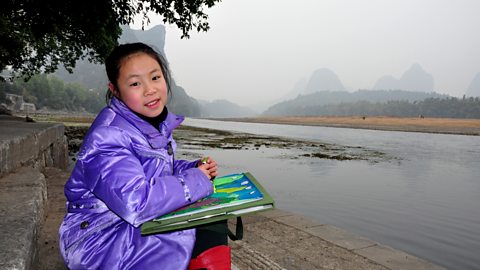
A child-led tour of Xingping in Guangxi Province in China.