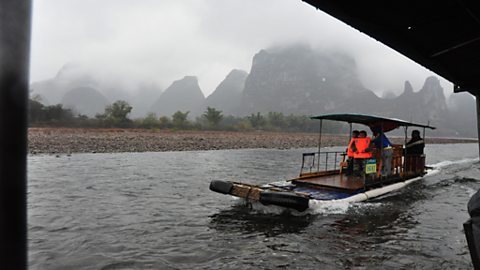
A child-led introduction to Sandouping in Hubei province, China, suitable to support study of a location in Asia at KS3.
The video
KS3 Geography. Life in China
Sandouping
MEMGKE: My name is Memgke. I’m 11 years old. [TRANSLATED] I live near Sandouping in the province of Hubei. Hubei province is in central China.
NARRATOR: The town of Sandouping is on the banks of the Yangtze River and has a population of about 35,000 people.
MEMGKE (TRANSLATED): My house is on a hill. At the bottom of the hill is the Yangzte river. My family used to live right next to the river.
NARRATOR: Memgke lives with her grandparents because her parents have had to find work in another part of China. The family like many others in the region were displaced when the Three Gorges Dam was built. Their farm is now underwater and they’ve had to find work elsewhere too far away to commute.
MEMGKE (TRANSLATED): From the roof of our house you can see the Yangtze river and the Three Gorges Dam. My Grandpa said he met a lot of foreigners when they were building the dam.
NARRATOR: The Yangtze provides all the water the dam needs to generate millions of kilowatts of clean and renewable electricity. It is then distributed all over China. But not everyone was happy about the dam. The people who lived by the river had to sacrifice their homes and way of life.
MEMGKE (TRANSLATED): Grandpa usually takes me to do the shopping with him. Today we’ve got lots of things to buy, because it is our Spring Festival!
The Spring Festival is also the Chinese New Year Celebration and the time when the majority of Chinese people take their annual holiday.
MEMGKE (TRANSLATED): It’s a very exciting day, because my Mum and Dad are coming home! So we have to get everything ready. Fireworks are very important for the Spring Festival. Everyone buys them. Even though Grandpa thinks they are not very safe…
MEMGKE (TRANSLATED): We can get most things in the market in Sandouping. Mandarins and oranges are some of the traditional fruits for the New Year celebrations. I like doing things with Grandpa.
NARRATOR: Even though they’ve lost their farm Memgke’s family work hard to provide as much fresh, home-grown food as they possibly can.
MEMGKE (TRANSLATED): My Grandpa has his very own vegetable patch. It’s not far from our house. I like going with Grandpa to get vegetables.
NARRATOR: The traditional Spring Festival feast takes a lot of preparation.
MEMGKE (TRANSLATED): I’m so happy and excited my parents are coming home! One last thing I have to do is sweep the floor. I haven’t seen my parents for nearly a year. My Aunt, Uncle and cousin have also come specially for the family reunion.
Now everything is ready and we just have to wait for my Mum and Dad.
NARRATOR: Memgke’s parents are travelling home from where they now work in Southern China. It’s 1,170 km away and it takes 13 hours to drive.
MEMGKE (TRANSLATED): Here they are! I am SO excited!
My Mum and Dad have brought presents for everyone. Lots of tasty sweets, new clothes and new shoes!
Dad has just finished having a rest. Now we can put all the decorations round the house. The colour red is very important, because we have an old story of an evil beast called ‘Nian’. It used to eat all the people’s food, and even eat little children. This evil beast hated the colour red. So that’s why red is lucky, because the evil beast will run away from red.
The scrolls mean ‘May happiness fall on everyone who comes in and out of the house.’
Tonight we will eat the dumplings that the whole family made together. These chocolates are in the shape of our ancient Chinese money. The ancient money was made from REAL gold and silver. All the food we eat is traditional for Spring Festival.
THE FAMILY: Cheers!!!
NARRATOR: Memgke and her family have lived through many changes over the last few years. The building of the dam has ensured regular water supplies and clean energy for many people across China, but it has been hard at times for the families now separated because of work. So they really make the most of the times they have to celebrate together.
Download/print a transcript of the video.
A child-led introduction to Sandouping in Hubei province, China.
Li Memgke lives near Sandouping in the shadow of the Three Gorges Dam, very close to the Yangtze river.
Her family had to move here when the dam was built because their home was in the path of the new construction.
The dam was built to protect parts of China from flooding and to harness the river Yangtze’s power to generate electricity.
It lies in the Gorge area of China, famous for its beautiful peaks and picturesque stretches of river.
Memgke lives with her grandparents, as both her parents have had to travel away for work.
They spend the whole year working in Guangdong province, over a 20-hour drive away.
Memgke is preparing for their return so that the whole family can celebrate Spring Festival (Lunar/Chinese New Year) together.
She goes into town with her grandfather to buy Chinese lanterns, decorations and fireworks and explains that red is the traditional colour for this celebration.
Once home, they prepare a Chinese feast and collect vegetables from their vegetable patch on the slopes of the hills near their house.
The food is traditional and there are many dishes. When her parents arrive they sit down together and eat, then let off Chinese fire crackers and watch the spectacular firework displays from the roof of their house.
This clip was originally broadcast as part of the series In My Shoes.
Teacher Notes
Download/print the Teacher Notes for this episode (pdf).
Teacher Notes prepared in partnership with the Geographical Association.
Before watching the video
- Using a map locate Sandouping. Zoom in and look at the terrain. How does it differ to the terrain they can see outside of their classroom window? What large features can they see on the map?
- Ask students what they think it would be like to live in this location. How does it differ from where they live? Students could create a list of their predictions.
- Introduce key terms such as:
Dam: a barrier built across a river or stream to control the flow of water.
Renewable energy: energy derived from natural resources such as the sun or the wind that are replenished at a faster rate than they are consumed. They also won’t run out.
Displaced: individuals or groups that have been forced to leave their home, for example due to the flooding of an area to create a hydroelectric dam.
While watching
You may wish to stop at relevant points during this short film to pose questions and check understanding, or wait until the end. Useful questions might include:
- Describe the landscape.
- Why were the family displaced?
- Why is the dam needed?
- Why are there contrasting views on the dam?
- Why is the Spring Festival important?
- Why are the parents having to work so far away?
After watching
- Take a closer look at the Three Gorges Dam and the Yangtze River. Discuss with students why they think the dam was needed and what impact they think this has had on people. Students could create a table of the advantages and the disadvantages of the dam. Students could also look at some of the wildlife affected, for example the Baiji a river dolphin which only lived in the Yangtze which is now thought to be extinct due to human activity.
- Set up a debate. One half of the class should investigate reasons as to why large-scale dams such as the Three Gorges Dam should be built, and the other half should look at reasons why they shouldn’t be built. Give students the opportunity to present their case. This could then lead to extended writing on whether dams have more costs than benefits. Students should consider the economic, environmental and social costs of these construction projects. This BBC page could be visited which looks at both the advantages and disadvantages of the Three Gorges Dam.
Where next?
- Using the Dollar Street website investigate the lives of other families around the world. This website gives you an insight into their lives and looks at different products that families have in their homes.
- Students could use this information to make a comparison to Li Memgke’s life and also to their own. Students could put this information into a table to enable them to make clear comparisons.
Links
Introduction to China:
https://www.bbc.co.uk/bitesize/articles/zk9h6g8
How is China changing?
https://www.bbc.co.uk/bitesize/articles/zt6cg7h
Curriculum Notes
This clip will be relevant for teaching Geography at Key Stage 3 in England and Northern Ireland, 3rd Level in Scotland and Progression Step 4 in Wales. The National Curriculum for Geography at KS3 requires the study of a location in Asia, 'including China’.
More from Life in China:
Life in China - Chan’gou video
A child-led introduction to Chan’gou in Yunnan Province, China.
Life in China - Lijiang. video
A child-led introduction to Lijiang in Yunnan Province, China.
Life in China - Shanghai. video
A child-led introduction to the city of Shanghai in China.
Life in China - Yangshuo. video
A child-led introduction to Yangshuo in Guangxi Province, China.
Life in China - Xingping. video
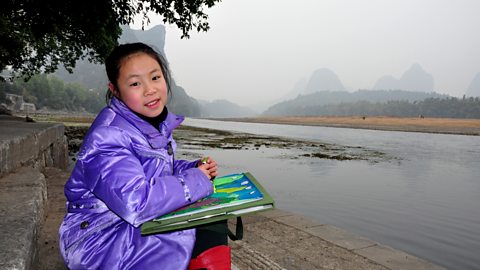
A child-led tour of Xingping in Guangxi Province in China.