Underground features
The formation of a limestone cave – before chemical weathering
The formation of a limestone cave – after chemical weathering
Underground cave
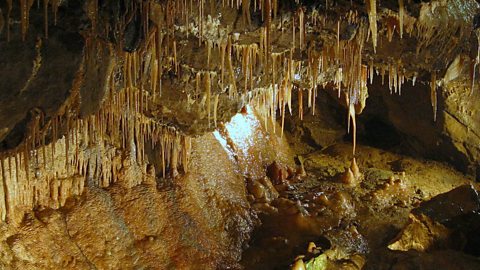
Inside a cave with stalactites and stalagmites
Inside the cave are a number of distinctive features, which have formed over thousands of years. They are all the result of water permeating the rock and dissolving the limestone.
- Large caverns can form underground in carboniferous limestone landscapes. They form when chemical solution is more active.
- They can also be enlarged by the usual processes of river erosion – Erosion caused by the force of river water hitting cracks in the side of the river bank. The air in the cracks becomes compressed and then explodes outwards, breaking off bits of rock., corrosion and When rocks carried by water wear away the landscape (also called abrasion)..
- As water flows underground it dissolves the limestone around it.
- The dissolved limestone (calcium carbonate) is carried away by the water in solution.
Stalactites, stalagmites and pillars
- Water drips from the roofs of caverns very slowly and The process in which a liquid changes state and turns into a gas.. As the water evaporates, through a process known as When calcium carbonate is precipitated out of solution when water evaporates inside a cavern., solid calcium carbonate is When particles of calcium carbonate are added to an underground limestone feature. on the cavern roof.
- This will build-up over time to form long, thin deposits which grow downwards and look like icicles hanging from the ceiling of a cavern - these are called stalactites.
- Some drops of water fall to the floor of the cavern where they splash and evaporate.
- The splash spreads the deposit of calcium carbonate and as more and more calcium carbonate builds up on the floor, short, wide, dumpy features grow upwards from the ground - these are called stalagmites.
- Occasionally stalagmites and stalactites grow towards one another and join to form a rock A piece of limestone formed by the fusion of a stalactite and stalagmite..
