First established in the late 7th Century, Wenlock Priory is the oldest of all the monasteries in Shropshire and was also once the wealthiest. The 7th Century was a turbulent period in Saxon Britain, as pagan leaders faced a new challenge, Christianity. King Merewalh of the Magonsaete, whose territory covered much of present day north Herefordshire and south Shropshire, founded Wenlock and Leominster Priories following his conversion to Christianity. Marewalah quickly installed his daughter, Milburga, as Wenlock's first Abbess, and she was later canonised. You can still visit St Milburga's Well, which is reputed to have healing properties and could even help you find your true love - Victorian women would hope to find a suitor after a visit to the well! 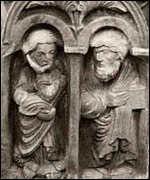 | | Detail from Wenlock Priory |
It's no wonder then that Roger de Montgomery decided to found a Cluniac monastery on the same site around 1080. When St Milburga's bones were later allegedly found near the monastery, the priory established itself as a popular pilgrimage destination - the medieval equivalent of a tourist trail - and had a sure-fire money-spinner on its hands. Coming to England from the abbey of Cluny in Burgundy after the Norman invasion, the Cluniacs were similar to the Benedictines, though placed a greater emphasis on both ritual and academic study. However, the later residents didn't seem to match St Milburga's high standards. Just 20 years before the monastery's 1540 dissolution, an official report recommended that monks "must not indulge in late drinking... must not hunt, and their dogs must be expelled from the cloister"*. Wenlock Priory was surrendered to the King's commissioners in January 1540 and part of the monastery was converted into a private residence (and remains inhabited to this day). The priory was redeveloped in the 12th, 13th, 14th and 15th Centuries and many of the best remains date back to later periods. One of the oldest part of the ruins belong to the Chapter House (around 1140). The building work was funded over the years by the monastery's wealth and even today you can get a sense of the elaborate architecture, particularly around the 350 foot long church. Standing within the site, it's easy to imagine how impressive the structure once was and it's a favourite locaton for tourists, locals looking for a little peace and even photographers. Wenlock Priory is owned by English Heritage and is open to the public throughout the year. Visit English Heritage's website for more information on opening times. |