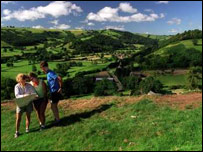
Some of the finest stretches of the dyke’s remains lie in Shropshire, particularly around Oswestry, Chirbury and Clun. In the 8th Century Offa was a powerful Saxon king, and his territory of Mercia stretched from the Thames Valley in the south to the Mersey river in the north. Shropshire was at the kingdom’s most western extreme and faced trouble from the marauding Welsh. | "Nowhere is the power and grandeur of 8th Century Mercia better displayed than here on this windswept south Shropshire height [Llanfair Hill]." | | Michael Watson |
Marking the border with a dyke wasn’t an original idea, Wat’s Dyke had been built a few years earlier. However, Offa’s version (constructed 757-796AD) was a far more ambitious project. It might not seem imposing today, but Offa’s Dyke was a major feat of engineering. Although featuring 130km of earthworks, the dyke also incorporated natural defences (such as mountains) where possible. This allowed the defensive works to stretch from sea-to-sea, some 240km! In parts the dyke measured 20 metres across and averaged some four metres high. Over the years farming has levelled parts of the dyke. Yet, large stretches can still be traced and it remains the longest archeological monument in Britain. A national trail follows the route for around 176 miles from near Chepstow up to Prestatyn, and is one of the most popular trails in the country. Some of the best stretches of Offa’s legacy are in Shropshire. Llanfair Hill, at 408m is not only the highest point of the dyke, but according to archaeologist Michael Watson, it’s “Perhaps the most magnificent section of all along the entire length of Offa’s Dyke.”* 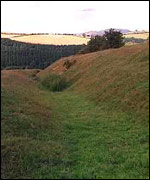 | | Edenhope Hill |
After the 8th Century, the dyke soon became redundant. There remained a need to protect England’s border from the Welsh for many centuries to come and a need to mark that border. However, Offa’s Dyke was simply not up to the job. It’s questionable if the dyke ever truly served its purpose, as the Welsh continually retook territory beyond it. However, it remains one of the greatest civil engineering works in Britain’s history and a major feature of Shropshire’s landscape. * Reference ‘Shropshire – An Archeological Guide’ by Michael Watson; published by Shropshire Books. |