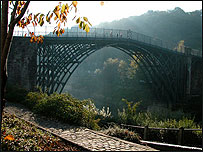
Until the iron bridge was built, the town of Ironbridge simply didn't exist. However, people were so drawn to the site of this engineering marvel, that hotels and other establishments began to sprout up to cater for the burgeoning tourist industry. Tourists have been coming to Ironbridge from all over the world ever since. While the industrial revolution is generally regarded as a triumph of coal and iron over nature and aestheticism, Farnolls Pritchard's iron bridge is not only an iconic design, but a beautiful one. Visitors to the Ironbridge Gorge will be hard-pushed to imagine it as a smoke-spewing workshop. Today, it's one of the most beautiful locations in the UK and The Midlands' only World Heritage Site. 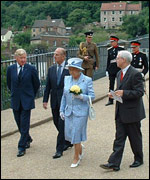 | | The Queen visits Ironbridge in 2003 |
Designed by Shrewsbury architect Thomas Farnolls Pritchard for young industrialist Abraham Darby III, the iron bridge was not only a feat of engineering, but a leap into the unknown. Abraham Darby I had pioneered the smelting of iron with coke, and the use of sand moulds, effectively launching the Industrial Revolution. But the use of cast iron remained relatively small scale for the best part of the 18th Century, partly because of its expense, but also because as a building material iron was still an unknown quantity. It was perhaps inevitable that this area of Shropshire and The Midlands would be the testing ground. It was the Silicon Valley of its day and many iron-related world firsts took place here. With the might of the Coalbrookdale Company behind him, as well as the support of many key industrialists, particularly 'Iron Mad' John Wilkinson, 29 year old Darby managed to finish the building of the bridge in just three months in the summer of 1779 - though the approach roads would take another two years to complete. Pritchard would never see his design realised, dying in 1777. 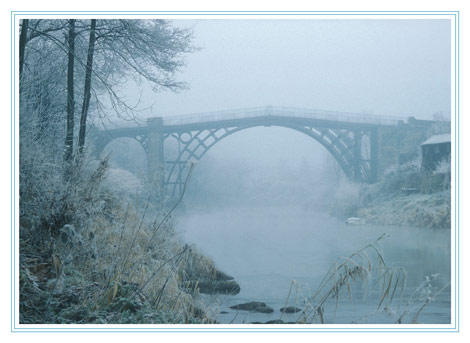 | | Ironbridge by Jon Baker |
Weighing in at 378 tons and featuring a total of 1,736 iron castings, the bridge was assembled by builders more used to carpentry. Rather than nuts and bolts, castings were secured in place with a complex series of joints. The sections themselves were all individually cast in the Bedlam furnaces (just 500 yards away), rather than prefabricated. How the bridge was actually built remained a mystery until 2002. Read our feature on the Mystery of Ironbridge solved.
Building the iron bridge > Although the 100 foot long bridge is dwarfed by its modern counterparts, it remains (arguably) the most famous of them all and a potent symbol of industrialisation. The iron bridge is not only a wonder of The Midlands, but one of the wonders of the modern world, as its World Heritage Site status affirms. One of the greatest engineering projects of the late 20th Century was the Honshu-Shikoku scheme - a huge series of bridges which linked up the southern islands of Japan (two of them are among the ten longest bridges in the world). The achievement is marked with a popular visitors centre... in which stands a model of Darby's iron bridge, still the benchmark of engineering innovation. The decision to span the Severn with iron was a risky move and Darby drastically underestimated the cost. The project went considerably over budget and Darby died in 1791, leaving huge debts. However, his legacy is great, in a single stroke ensuring his place in history. The Darby family were quakers and as such, no portraits of them were ever painted. However, it's believed that if you look carefully enough, you'll see a likeness of Abraham Darby III's face within part of his bridge. |