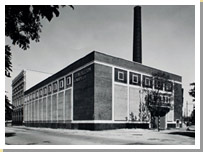
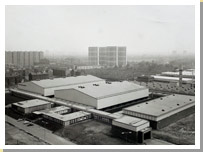
In 1839, a new process had been invented by James Templeton of Glasgow that made possible an increased colour range being used in carpet designs. Templeton's became a major employer in the east end of Glasgow. In the 1930s, the company built a large factory beside Glasgow Green. This building's exterior was designed to resemble a palace in Venice! These sources provide us with valuable information about the design of Scottish carpet factories when the industry was a major employer in Scotland.
Robert Biggin Stoddard archivist 2004.
"The factory was Templeton's on Glasgow Green, the building that was designed in the style of the Doge's Palace in Venice. The reason why it was designed like that was James Templeton himself came from Paisley. He was a shawl weaver. He thought to himself he could probably use the method of shawl manufacture to make carpets. So he moved from Paisley to Glasgow and took over an old factory in Glasgow Green. As he progressed, he decided he wanted to build a new factory. He got a designer, an architect to design a new factory building. But the first two lots of plans were turned down by the Glasgow city fathers and so he then asked Sir William Leiper, who was a famous architect of his day, and he said "Well we'll design something which the city fathers cannot turn down". And that's why it's built in the style of the Doge's Palace."
Templeton carpet factory, Crown Street Glasgow 1968