 | Inspiration, fashion and design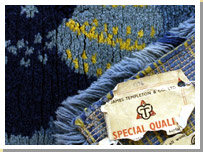 | 'First class' dining room carpet from the liner, Queen Mary |
Carpet designs after the Second World War reflected changing fashion in home furnishings. Customers could afford to buy new carpets more often, so producers changed colours and designs more frequently. From the 1930s, wide-width carpet (4.5 metres wide), known as Broadloom, was commonly available. This meant more people could afford wall-to-wall or fitted carpets and this meant more customers for Scotland's carpet factories. In the 1960s and 1970s, the fashion for wooden floors with rugs meant fewer middle class customers were willing to buy expensive carpets. Foreign markets were disappearing and Scottish companies discovered that Scottish customers were not interested in the 'old fashioned' designs that had been popular in Australia and New Zealand.
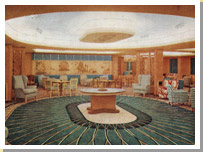 | The liner "Arcadia" |
The Americans were responsible for two major innovations in carpet manufacture in the 20 th century. In 1930 they introduced a new method of making carpets which produced 'tufted' carpets. It was quicker and used less raw material than old methods. Tufted carpets now account for over ninety percent of world carpet sales. Then came man-made fibres. At the time, the fashion was for plain or single-coloured carpets and this suited the cheaper, tufted, synthetic variety. Customers chose these cheaper carpets rather than more expensive high quality carpets woven from wool.
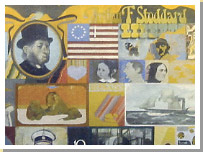 | Detail from John Byrne's Stoddard mural courtesy of Paisley Museum and Art Gallery |
Scottish factories had always manufactured carpets for 'one off' prestige projects such as carpets for public buildings, passenger ships, hotels, shopping centres and special events. Now they relied on these orders to keep their factories in production.
|  | |
|


