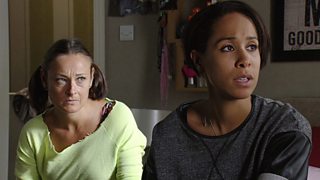
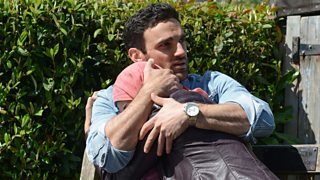
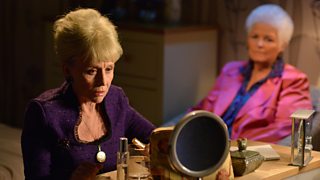
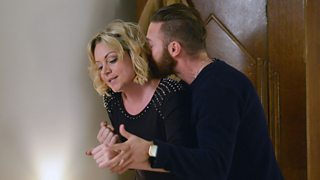
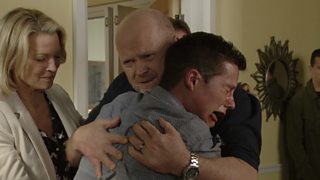
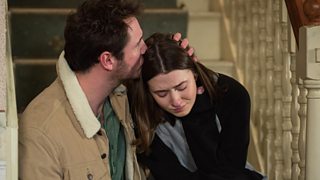
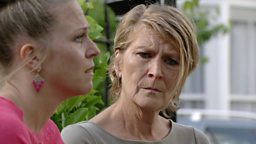
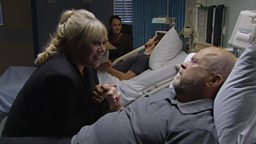
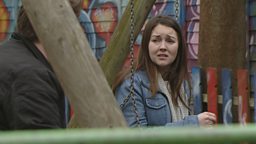
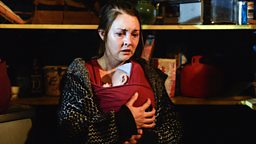
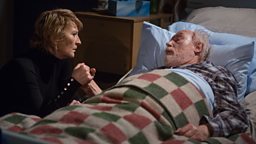
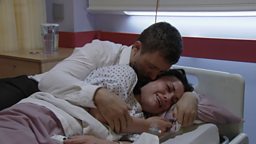
Stacey's Story: Working with Mind
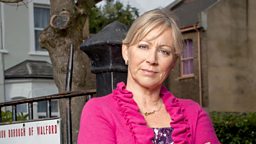
Sands, the stillbirth & neonatal death charity, has worked extremely closely with EastEnders to ensure that this story was portrayed as truthfully as possible. Below, Erica Stewart (Bereavement Support Services Manager at Sands) talks about working with EastEnders on this storyline.
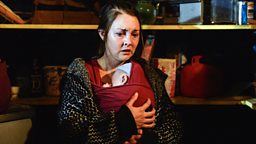
We were first approached to help EastEnders with the current postpartum storyline many months ago. This caused great excitement, firstly because we were consulted from the very beginning of the process but also because it involved Stacey Branning - a character who we had been advising on since before her diagnosis of bipolar disorder in 2009. In fact at times it feels as though she is like my little sister the amount of time I spend reading or thinking about her!
At Mind we are quite unique, as alongside our traditional 'media team' who help journalists and promote the work that Mind do, we also have a media advice service dedicated solely to ensuring that onscreen portrayals of people with mental health problems are accurate and sensitively done. A lot of our work involves working with serial dramas instead). Some people may question what value this has but we know that serial dramas have an amazing opportunity to shape and challenge attitudes, raise awareness and dispel myths. Watching a character on screen with a mental health problem may be the first time someone watching is exposed to mental health problems. We also know that millions will happily follow the shenanigans of The Square weekly but would never dream of switching on a documentary.
Our process of working on the Stacey storyline has been our most in-depth yet and this is very apparent on screen. As well as offering advice on symptoms and treatment we have helped the scripting process from first draft right through to the shooting script, making comments and suggestions to try and ensure that the character and those around her remain realistic and unlikely to cause any distress or issues for those of us with mental health problems.
As part of this process we have spent a lot of time talking to women who have experienced postpartum psychosis who have been through very similar experiences to Stacey. Listening to them sharing their stories has been both very sad but also very inspirational. Thankfully this really is an illness that if treated appropriately has a really good prognosis. Women can and do recover. We have been working with the great charity Action on Postpartum Psychosis who have also supported the storyline.
In particular we have been working very closely with two incredible media volunteers, Eve and Kathryn, who have helped us paint a picture for EastEnders of what it's really like to live with the condition. Not only have they helped with questions around symptoms or treatment but they have also shared their incredible stories with us but with the researchers and writers at EastEnders. They have even been in to talk to Lacey Turner and James Bye, who play Stacey and Martin. I know that parts of the storyline have been influenced by stories from women like Eve and Kathryn and, after all, who needs to make up stories when real life is so dramatic.
The reaction to the storyline so far on social media and within our supporter network has been overwhelmingly supportive. Many have said that they had never heard of this condition before, which is one of the reasons for doing this storyline. Some women who have also been through this experience have said that it is hard to watch but incredibly important to get out there. They have also said that watching Stacey is like watching themselves. There are some who may think that this is a 'typical' soap opera storyline that wouldn't happen in real life. However the women we have worked with say that their 'real' stories are far darker and really not suitable for television.
We hope that the story will raise awareness and bust a few myths around this very misunderstood illness. We want the millions of viewers to know that it is pretty rare (1-2 in every thousand births but much more likely in women who already have bipolar disorder like Stacey) and needs to be treated as a medical emergency, but that women will generally recover with the right help. Those in their armchairs also need to know that women with postpartum psychosis are not generally a danger to their child or bad mothers and that it is incredibly rare that women have their children taken away.
An added bonus will hopefully be that people may seek help after seeing this storyline. Not only women who are concerned about their own condition, whether or not it is postpartum psychosis or any other perinatal mental illness, after all suicide is one of the leading causes of death from pregnant women or those who have given birth. We also hope that those around them such as partners, friends or family may be encouraged to seek help or even just start up a conversation, after all the more this is talked about the more 'normal' it becomes. We know that soap stories can really encourage people to go and see their GP, call a helpline or just get in touch with a friend or family member with a mental health problem.
And most of all of course we hope for a happy ending for Stacey - but being EastEnders we know that this might not happen!
To find out more about Postpartum Psychosis and the work Mind did with EastEnders, go to http://www.mind.org.uk/Stacey
Our full support database
![]()
Online safety and cyberbullying
Help from BBC Stay Safe and partners.