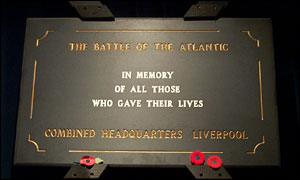
| | The Battle of the Atlantic |
"As many Merseyside men - and women - will tell you, this city made a key contribution to victory in World War II. 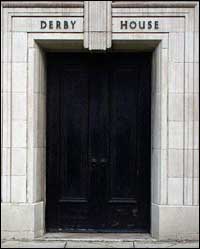 | | Derby House - home of Western Approaches |
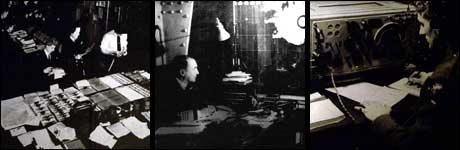
Merchant shipping based here kept the nation supplied with food and raw materials. Combined Operations, which was responsible for control of the Western Approaches, was moved in l941 from Plymouth to Derby House, part of Exchange Buildings. This move was instigated by Winston Churchill. The complex - which was known locally as the "Citadel" or "Fortress", was designed to be bomb proof and gas proof, with a 7ft. thick roof and 3ft walls, and 100 rooms covering an area of 50,000 square feet. The Royal Navy, Air Force and Royal Marines worked jointly to monitor enemy convoys and "wolf packs" of submarines which threatened to bring Britain to her knees in the early part of the war. Probably the most important area in Western Approaches was the decoding room, in which the ENIGMA DECODING MACHINE was kept. This machine had been recovered from a sinking U boat, along with the code books, but tragically the sailors who saved them were lost. The main operations room contained giant maps of the North Atlantic, the Western Approaches and the British Isles, upon which convoys and wolf packs were plotted with Wrens moving them around, using large mobile ladders. | WREN's at the plotting table. | Sir Max Horton - at his desk which looked out to the Plotting Room. | Communications consistently came in and out of Derby House. |
The most famous event in Western Approaches history is probably the hunting down of the Bismark. Sir Max Horton, commander in chief of the Western Approaches from l942, is buried in the Anglican Cathedral. "
|