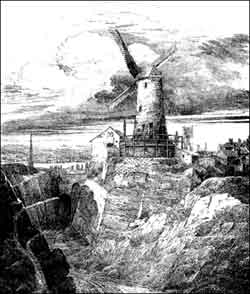
| | The Mill stood in the place where the Oratory now stands. |
St James' Cemetery began life in the 1600's as a sandstone quarry.
The quarrymen constructed a tunnel to ferry the stone to and from the site. This tunnel - although still in existence is blocked up.
| “Loss of appetite, nervous disorders, Lowness of spirit, headaches proceeding from crudities of the stomach, Rickets and weak eyes.” | | Uses for the water from the spring discovered in 1773, according to James Worthington. |
By 1825 the useful stone from the quarry had been exhausted and the town council had to decide what was to be done with the quarry. The corporation raised nearly £20,000 by public subscription and employed architect John Foster (1786 - 1846) to design and lay out a cemetery along the same lines of the Pere-la-Chaise, Paris. This new cemetery would relieve the pressure on the Low Hill Cemetery, Everton where it was getting difficult to prepare a new grave without disturbing another corpse! 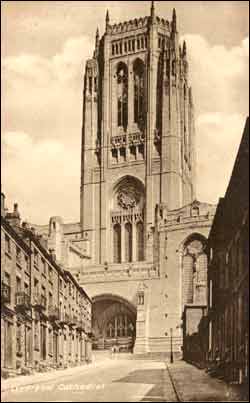 | | The Anglican Cathedral was completed after the cemetery stopped being used. |
In 1894 a proposal was made that the cemetery should be filled in and the land set aside for other uses which prompted a public outcry.
Mr. T.W. Christie wrote to Bishop Ryle:
"At last it is disclosed that not only have ye been nursing the plot in secret, but have actually passed a vote of thanks to Mr. Lister for his plan for filling up the cemetery from end to end. A monstrous and inhuman proposal to say the least of it." The cemetery soon became well used with up to 8 burials per day during the Victorian era.
It finally closed in July 1936, when, after 57,774 burials it was considered full. St James Cemetery is now a conservation area, and a nature conservation site, Grade 1.
|