|
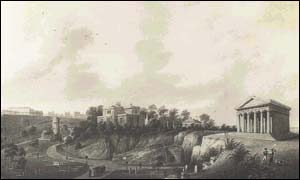
| Print by Robert Irving Barrow from 1830.
Courtesy of Mike Faulkner. |
There are 3 tunnels leading into (or out of) the cemetery.
1) The Pedestrian walkway 2) The Quarryman's Tunnel 3) The Hearse Tunnel Although there is no definite evidence to confirm the uses of the tunnels these are the widely held views: -
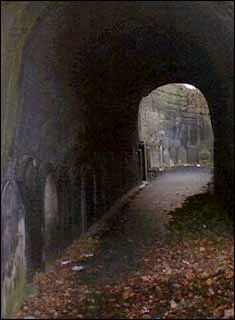
The Pedestrian Walkway 10 feet wide and 12 feet high it follows a downward slope from the left of the main Cathedral entrance. It has been called a 'natural arch' by some Ordnance Survey maps but chisel marks are plainly evident on the walls and roof point to the fact that this tunnel has been 'worked'. Today the tunnel walls are decorated by gravestones which were moved during the transformation to a public garden.
It is possible to see find the initials of long dead stonemasons carved into the sandstone, together with the dates.
Look out for J.F.P 1856.
Because of the winding nature of the path leading to this tunnel, it is unlikely to have been used for little else than pedestrian traffic.
| | The Quarrymen's Tunnel This tunnel is some 4 metres wide suggesting that it was used for the transportation of heavy, difficult loads. Possibly this was the early Quarrymen's route out of the Quarry with their loads of stone. It caused a problem during the 1960's when the Anglican Cathedral was nearing completion.
In his book The Building of Liverpool Cathedral, Peter Kennerly writes;
"The preparation of the foundations for the West Front was hampered by the presence underground of an old collapsed tunnel, which had been excavated in the eighteenth century to give access to the quarry."
Just to the right of this there is a very concentrated amount of early 19th century graffiti. This could this indicate that the workers of the day spent idle time here. | | The Hearse Tunnel 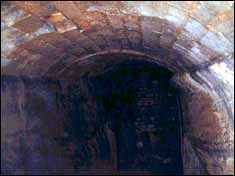 | | Image courtesy of Marc Williams |
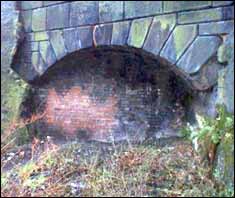
Almost facing the quarrymen's tunnel, hidden among trees and ivy, lies another tunnel.
Currently it is bricked off with blocks of distinctive yellow sandstone, there is a small gap at the top and through this we can see how the roof is very well dressed. It emerged at the junction of Rodney St, St. James St and Duke St. Close to the home of a Dr. Gill. |
|
| |
|