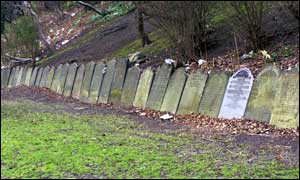
| | The edges of the cemetery are lined with the gravestones that were moved from the centre of the cemetery during renovation work. |
"Cemetery History
The cemetery began life as a quarry called Quarry Mount whose sandstone was used in the building of the dock walls and town hall. It was renamed St James’ Mount in 1775 after the building of the selfsame named church in Parliament Street. By 1825 there was no stone left and the council employed architect John Foster to design a cemetery based on the Pere-la-Chaise in Paris.
William Huskisson
Said to be the most famous resident of the cemetery, William Huskisson is the first railway accident fatality. MP for Liverpool he died during the Rainhill trials of 1829 at Parkside Station, where he fell beneath a train. 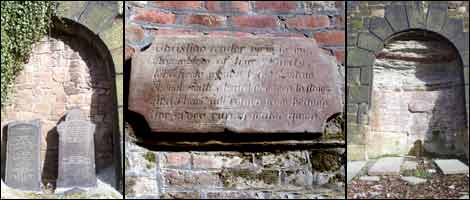 | The tombs in the catacombs | The inscription above the spring | Liverpool's only running spring |
The Spring
The cemetery contains Liverpool’s only running spring. Noted in 1773 by surgeon James Worthington who recommended it for 'Rickets, weak eyes, crudities of the stomach and lowness of spirits.' The inscription above the spring reads: Christian reader view in me, An emblem of true charity, Who freely what I have bestow, Though neither heard nor seen to flow, And I have full returns from Heaven, For every cup of water given.
Graves & Gravestones
Many children who died at the orphanages and hospitals in Liverpool were laid to rest here including 14 children from the Bluecoat hospital between 1867 and 1887. Burials continued in the cemetery until July 1936, when, after 57,774 burials, the old cemetery was considered full. During the Victorian era the cemetery was being filled at the rate of sometimes eight burials a day. 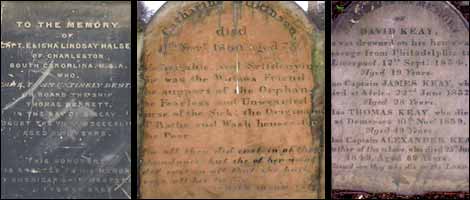 | Captain Elisha Lindsay Halsey of South Carolina, USA, who, aboard the ship Thomas Bennett, came to an untimely death in the Bay of Biscay in 1844 | Kitty Wilkinson - 'indefatigable and self-denying, she was the widow's friend, the support of the orphan, the fearless and unwearied nurse of the sick, the instigator of Baths and Washhouses for the poor' | David, James and Thomas Keay, all lost while away at sea. It would seem that this was a family of seafarers, their father, Captain Alexander Keay, died ten years after his sons, and joined them in their grave. |
The Cathedral
In 1903 the properties on the Mount were purchased for £11,300 and on the 19th July 1904 the Anglican Cathedral's foundation stone was laid by King Edward VII and Queen Alexandra. 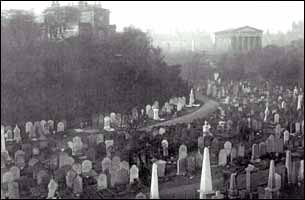 | This picture shows the cemetery in 1902.
Image courtesy of Mike Faulkner |
Hearse Tunnel
This tunnel’s roof is made from quality brickwork and is thought by many to have been used by hearse traffic. It emerges at the junction of Rodney, St James and Duke Street. Quarrymen's Tunnel
Carved into the walls by the tunnels is a large amount of graffiti, including some dating back as far as 1797 possibly done by quarry workers. Pedestrian Tunnel
About 10 feet wide and 12 feet high this tunnel has been called a 'natural arch' by some Ordnance Survey maps. However chisel marks on the walls and roof are visible. The tunnel can been seen on drawings dating from 1830. It is thought because of its winding nature that this tunnel was only used for pedestrian access. Today the tunnel walls are decorated by gravestones which were moved during the transformation of the cemetery to a public garden. "
|