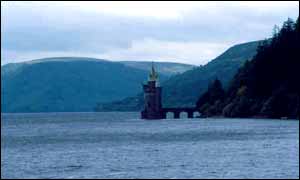
| | Lake Vyrnwy supplies lots of Liverpool's water. |
In l847, Liverpool promoted the Liverpool Water Act, which allowed it to look for water outside the city limits. Additionally, the city took over the local sewerage boards and appointed James Newlands as City Engineer. To replace groundwater supplies, surface reservoirs had to be built. The first of these was at Rivington Pike, 30 kilometres to the northeast, at the foot of the Rossendale Hills. The Rivington reservoirs are on the western flank of the Pennines, below Anglezarke Moor, occupying a deep valley. The Dam project was passed in l847, but it was highly controversial and battles raged between the "Pikists", the supporters and the "Antipikists". 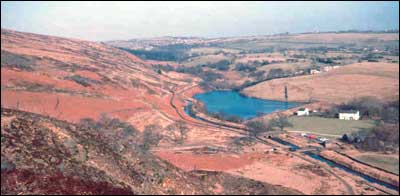 | | Rivington Pike in a fault line valley from Anglezarke Moor. |
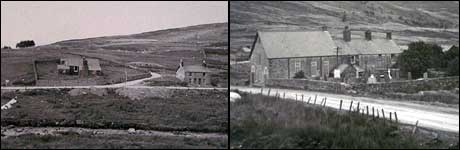
The matter was resolved by the celebrated railway engineer George Stephenson, and the project went ahead. In August l857, the first water from Rivington was delivered to Green Lane in Liverpool. It was brown at first, and had to be mixed with clean well water to make it more palatable. Today there are 8 impounding reservoirs at Rivington, with a total storage of over 4,000 million gallons from a modest catchment of 9,710 acres. Demand soon outstripped the Rivington supply, and in l866 Liverpool’s Water Engineer, Mr. Duncan, investigated alternative surface supplies from the Lake District, the Pennines and Wales. | Llyn Celyn - which became a reservoir to supply Liverpool with water. | Trywern Chapel - 1963 | Image © Liverpool Records Office, Liverpool Libraries. |
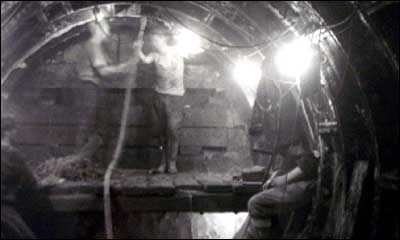
In l879 it was decided to build a dam at Vyrnwy. The first stage was completed in 1892, the dam took 10 years to complete fully as additional catchments were added. The acqueduct to bring the water from Wales to Liverpool was a major feat of engineering, and took the form of cast iron pipes underground. The first water from there was delivered directly to Green Lane, in Liverpool, and then piped to consumers. The water was brown, and clean well water had to be mixed in to make it more palatable. In l865, a drought threatened supplies, and by September of that year the situation was so acute that domestic supplies were reduced to one or two hours a day. The drought had a disastrous impact on trade, and health, in Liverpool. Public baths and wash houses were closed, and epidemics claimed many lives… the situation was relieved somewhat by the autumn rainfall. | Tunnelling for water at Llyn Celyn in 1963.
Image © Liverpool Records Office, Liverpool Libraries. |
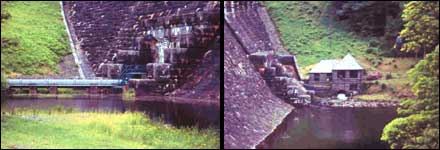
Another great drought struck in l884 and indeed, a hose pipe ban was imposed - sounds familiar, doesn’t it? The River Dee has also been exploited as a source of water for the city, performing the same function as the Vyrnwy aqueduct in conveying water to the urban areas of the North West. The headwaters of the Dee contain a series of lakes in which water is stored to regulate the flow of the river so that a steady supply of water can be abstracted downstream. | | The north east and south west valve chambers from Lake Vyrnwy. |
Local service reservoirs were constructed to provide short term supplies. They were usually built in elected locations so that water could flow downhill, under gravity, saving the cost of pumping. 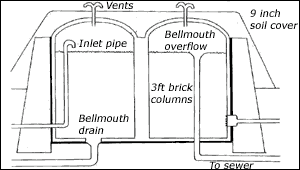 | A diagram of how the local service reservoirs worked.
© Jim Moore |
Some still exist as they were built - the one in Reservoir Road, Woolton, the highest in the city, Dudlow Lane, next to the Halfway House in Woolton Road and Aubrey Street which includes a listed water tower. Some have been put to new use, including High Park Street, presently undergoing renovation as a community space, thanks to Dingle 2000. |