"Some merchant ships carried Spitfires and Hurricanes and these were launched by catapult. More often than not outside of the range of an aerodrome, so that the pilots, mission completed, had to ditch and hope they were plucked out of the sea before they drowned or died of exposure. So by no means was The Battle of the Atlantic, just a Navy show.
We lost ships in convoy that probably would have escaped torpedoes if they had sailed independently and at their top speed, as the Queen liners did. But merits of convoy far out weighed disadvantages.
City of Benreas torpedoed 56 degrees, 43 minutes north, 21 degrees, 50 minutes west, sinking, proceed immediately. The position was 200 miles from us. We reached it on the afternoon of September 18th.
|
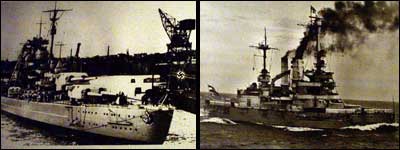
| Two German ships on parade. |
First we saw a raft, there were two girls on it in pajamas and a man with a smashed leg. One of the girls lay almost senseless, her hand clutched by the man. They had been on that raft, drenched by the sea, chilled by an icy gale and stung by hale stones for 19 hours.
We saw an upturned boat. Two school girls were clinging to it. There was a boy aged 9 sharing another raft with two men, one of them with his head split open. How can you not weep when you see something like that.
The little boy on the raft, he was a Londoner, Jack Keely. When he was carried up the netting, which had been flung over the destroyer’s side, he grinned and said "I say, thanks very much". You stand abashed at courage like that.