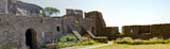
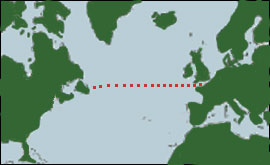
The islanders would sail across the Atlantic every spring, returning in time for the autumn ploughing. Jersey's second major industry at this time was knitting, and it began to dominate island life - so much so that a law was passed to outlaw knitting during harvest and vraicing seasons! The threat of war In 1593 it was decided that a new castle needed to be built, because of the threat of the Spanish and the French. Work commenced on the construction of Elizabeth Castle in St Aubins Bay. In 1627 Philippe de Carteret became Bailiff, and enlarged Elizabeth Castle to more than double its size. The English Civil War Jersey had been peaceful for 10 years before the start of the Civil War in 1642. Although the war had little to do with Jersey, the island was drawn into the struggle. Philippe de Carteret tried to stay neutral, but his nephew George was an ardent Royalist whilst the sympathy of the islanders was with parliament. When Philippe de Carteret became ill and died in 1643, George de Carteret took over. George was determined to hold the island for the king, but the Parliamentarians recaptured Jersey in 1651. Growth of the town St Aubin became the main town in Jersey from around 1680, because it was the principal port in the island. Larger ships could now stay here instead of St. Malo. But in 1786 the States agreed for a harbour to be built in St. Helier. This soon overtook St. Aubin as the principal port, and a larger town grew up around it. Attempted Invasion The 18th century was another period of political tension between Britain and France, and Jersey once again became a military standpoint. There were two attempted invasions during this time. In 1779 the Prince of Nassau was prevented from landing, but in 1781 French soldiers captured St. Helier in a dawn raid. They were defeated by the British troops led by Major Peirson, who was killed during the battle. This episode became known as The Battle of Jersey. Secret networks This war was followed by the Napoleonic wars, which lasted until 1815. There were two underground networks operating during this time. One was led by James d'Auvergne, who worked for the French royalists. The other network was in close contact with Napoleon, and they constantly monitored d'Auvergne until the war ended.
|