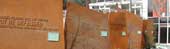
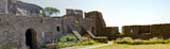
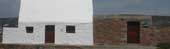
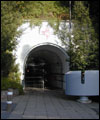
 | | The entrance to the hospital |
Jersey was meant to be an essential part of Hitler's Atlantic Wall. The War Tunnels are only one of many fortifications that the Germans built on Jersey. Slave labour In order to build the tunnels, a huge workforce was needed, and this was supplied by the Organisation Todt. More than 5,000 slave labourers were brought over to Jersey - Russians, Poles, Frenchmen and Spaniards. The men were treated harshly, but the Russians suffered the most. They were seen to be sub-human, and were treated like animals. Men are known to have died from disease, malnutrition, accidents and exhaustion. How the tunnels were made 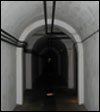 | | One of the corridors in the hospital |
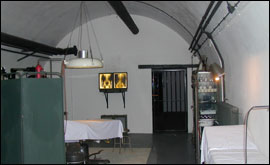
The tunnels were blasted out with gunpowder and handtools, and then covered with concrete. The hospital was dug into a slope, so that it would drain naturally. Its location within the hill also ensured that the temperature remained at a constant temperature throughout the year. D-Day draws nearer The tunnels were originally constructed as an ammunition store and artillery barracks, but the Germans converted them to a casualty clearing station as D-Day drew nearer. Unfinished tunnels were sealed off, and air-conditioning and heating systems were sealed behing gas-proof doors. Wards were added, along with an operating theatre, a medical supply room, a casualty assessment centre and a dispensary. Today Today, the Jersey War Tunnels house 'Captive Island' - an exhibition dedicated to how the occupation affected the islanders and the island. The operating theatre and other areas have been restored to show how the hospital looked during the occupation.
|