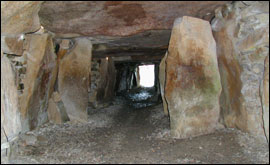
The burial chamber The mound covered a passage grave and burial chamber. The passage grave consisted of a narrow passage leading to a large oval chamber. Two small side chambers projected from the north and south walls. A raised platform led to a small end chamber located at the western side of the main chamber. This area was probably the most sacred area of the site. Construction 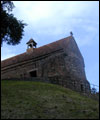 | | The chapel on top of the burial mound |
The large upright stones and capstones in the tomb itself came from various places in the east of the island. They would have been set into place using earth ramps, wooden rollers and a lot of manpower. Use of the tomb Although referred to as a tomb, the site would probably have served a much more complex purpose, with a number of ritual and ceremonial functions. It remained open and in use for several centuries, before the tomb was finally sealed and the site abandoned. From pagan to Christian La Hougue Bie would have been recognised as a pagan site from early times, and was christianised in the twelfth century.  | | Painting of a saint on the chapel roof |
A chapel was constructed on the summit of La Hougue Bie, and possibly replaced an older wooden structure. This chapel remained in use for about four centuries, until the Jerusalem chapel and crypt were built in 1520. Abandoned The chapels were abandoned around the Protestant reformation, and later fell into ruin. They were extensively rebuilt and reconsecrated in 1931. The towers La Hougue Bie was reoccupied in the 18th century. Shortly after 1780 the D'Auvergne family transformed the chapel ruins into a Neo-Gothic style house. 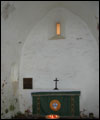 | | Inside one of the chapels |
The interiors of the chapels were extensively modified to produce a large hall with windows at both ends. At the end of the 18th century the house was abandoned and quickly fell into ruin. Effects of the German occupation The ruined towers of La Hougue Bie became an important landmark and tourist attraction. In 1859 it was described as 'the wonder of the island's wonders'. In 1920 the site was bought by the Societe Jersiaise for use as an historic site. But on the 10th March 1942 German forces began to build a battalion command bunker into the eastern side of the Neolithic mound. Over the next few years a total of 70 trenches were dug in the grounds, causing extensive archaeological damage.
|