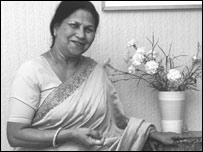
Both of my parents were of Bengali origin and originally hailed from the Khulna district. But after starting a family, which consisted of myself and two older brothers, they settled in the capital Dhaka. My father worked as a businessman and my mother a doctor. As a young girl, I studied at the Muniza Rahmen Girls High School where I completed my O-Levels before progressing onto my A-levels. 
I eventually moved to England to join my husband as my children missed their father. It was a difficult decision, but due to the nature of my job, it became difficult to devote time to my children as well as my career. | | Sakina Swarwar Choudhury |
It was during this time that I realised my obvious passion for the sciences. It was that passion that led me to complete my BSc degree at Eden Girls College in Dhaka, reputed to be the best in the country, and it was my thirst for knowledge that led me to study for a further BEd degree at Dhaka University. After finishing that course, I chose a career as a teacher and began to study for an MSc in Botany at Dhaka University before joining the local college to teach botany as a lecturer. At this point television was a new medium and young people were being recruited to join the television corporation. I was one of the lucky ones to be chosen and based on the experience I had previously gained working in radio, I was given a job as a programme producer. On the radio I had been the broadcaster for Voice of America. These programmes were recorded in Dhaka and then sent to America to be heard around the world. But in television, I became a successful producer in what proved to be a competitive, challenging and exciting environment in which to work. 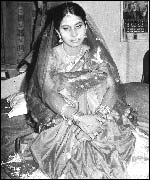 | Sakina Swarwar Choudhury as a young woman |
Shortly after joining I remember travelling to Pakistan TV at Rawalpindi for training. I came back to Dhaka and was promoted as senior programme producer. I strived to create an educational programme aimed at children and this led to a trip to Tokyo to collect the Japan Prize, which was given to me for my contribution to educational programming. I was the first woman to have received this award from Bangladesh Television. A year later, I collected another award for being the best producer of children's educational programmes in the country. During my career I also travelled to the BBC in London to be trained in educational television. Understanding Whilst still working, I was married in Bangladesh in 1972 to my husband, who is a doctor. Later that year he moved to England to train as a surgeon. I then had a son in 1973 and in 1981 I had a daughter. At this point, still in Bangladesh, I continued working as a producer, as well as looking after my children. I eventually moved to England to join my husband as my children missed their father. It was a difficult decision, but due to the nature of my job, it became difficult to devote time to my children as well as my career. However I don't regret anything. I have seen both my son and daughter through their education and both have followed the same career path as myself.
I hope Our Untold Stories will be a means of remembrance for those who identify with the stories within and a means of understanding of their origins for those whom are part of our younger and future generations. | | Sakina Swarwar Choudhury |
After graduating, my son went on to become a broadcast journalist at the BBC and my daughter works within a post-production company in London. Since 1990 I have been working as an ethnic minority achievement service teacher at Widden Primary School. I have also formed the Bangladeshi Women's Association, which has given me the chance to enjoy working with the community. I believe that projects such as Our Untold Stories will further the understanding and knowledge of the Bangladeshi culture within Gloucestershire. I hope Our Untold Stories will be a means of remembrance for those who identify with the stories within and a means of understanding of their origins for those whom are part of our younger and future generations. Most importantly, it serves as a means of reference for anyone wishing to understand a colourful and progressive culture. » See 'The Bangladeshi Community' |