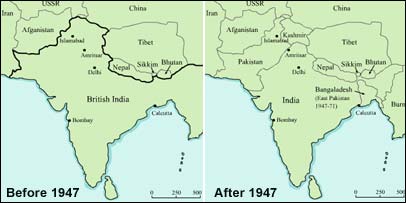
The Asian Community - An Historical Perspective Indian migration to Britain (and this includes Pakistani and Bangladeshi migration) is often thought to have started after India became independent in 1947. In fact, it goes back much further than that. It is the direct result of the long contact between Britain and India. This contact began in 1600 when Queen Elizabeth I granted a charter to the East India Company, giving it a monopoly of trade with India. 
In 1608, the first ship called on the west coast of India, at Surat, in the state of Gujarat. Most of the Asians living in Gloucestershire are from this port city. | | Our Untold Stories |
In 1608, the first ship called on the west coast of India, at Surat, in the state of Gujarat. Most of the Asians living in Gloucestershire are from this port city. British rule over India resulted in the movement of Indians to all the countries of the Commonwealth - including Britain itself. India was initially a source of cheap labour and Indians were used to fill the gap needed to run British-owned, labour-intensive industries. Indians built the East African Railway and worked as sailors on the British Merchant Navy. Indian soldiers fought for Britain in both world wars and many won some of the highest possible awards for bravery. Gloucestershire Records Office references to Asian people pre-1939 |  Great Barrington 9 Sept 1705 George Tudor 'a native of the Kingdom of Golconda' was baptised. Great Barrington 9 Sept 1705 George Tudor 'a native of the Kingdom of Golconda' was baptised.
Newland 6 February 1788 Thomas Pipe, an east Indian Black was baptised at Coleford Littledean 12 August 1879 John Delen 35 'mallotta' from Calcutta was given 7 days imprisonment for drunkenness at Newnham-on-Severn Cheltenham (Christchurch) 26 July 1882 Ruth an adult native of Madras, ayah in the service of Colonel Rowlandson, was baptised in the Tamil language Cirencester 21 February 1894 Sidh Bisill Mahli, child of Nozam Ull Din and Rasham Bibi Mahli of Badoo-Mahli, Punjaub was baptised. Father's occupation - private gentleman. Cinderford 1927 In memorium Dr M L Bangara 1881-1927 Doctor at Cinderford 1914-27 St Briavels c1930 Testimonial and subscription for Dr R N Nanda at St Briavels c 1923-c1945 |
Many servants and 'ayahs' (nannies) were brought to Britain during this period. Sake Deen Mahomed, the 'shampooing surgeon' (barber) to George IV, came to Britain with Captain Baker in 1784 and published his first book the 'Travels of Dean Mahomet'. He then moved to Brighton, then a fashionable health resort promoting sea-bathing for rheumatic ailments. There he set up a business as Mahmood's Baths, attracting the rich and the fashionable from far away. According to the limited historical references so far uncovered in the Gloucestershire County Records Office, the first mention of Asians in the county can be traced to the 18th century. Both references to Indians in Gloucestershire at this time are records of baptisms in parish registers. It is likely that both baptisms were of adult men. As was the custom, they were given English names. 'George Tudor' was described as 'a native of the kingdom of Golconda' - the ancient name for Hyderabad. His presence in Barrington seems to have been connected with Barrington Park, since two of his godparents were members of the Bray family, who owned the Barrington estate. The other godfather was Isaac Tullie, 'citizen of London'. All three 19th century references to Indians in Gloucestershire come late in the century. John Delen, a 'mallotta' (mulatto - of mixed race) from Calcutta, who was imprisoned for drunkenness at Newnham-on-Severn, was probably a seaman. 'Ruth', an adult native of Madras, had accompanied Colonel and Mrs Rowlandson on their return to Cheltenham from India as ayah to their children. She was baptised at Christchurch on the same day in 1882 as her youngest charge, Julia Rowlandson, though not by the same priest. A Tamil-speaking minister, the Rev Robert Pargiter, officiated rather than the Rev Joseph Fenn, the vicar. 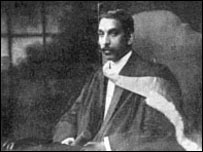 | Dr ML Bangara practised in Cinderford from 1915 until his death in 1927 |
At the other end of the social scale, Sidh Bisill Mahli, child of Nizam Ull Din and Rasham Bibi Mahli of Badoo-Mahli, Punjab, was baptised in Cirencester in 1894. His father was described as 'a private gentleman' and may have been on a visit to England. Since the 1950s, some south Asians have come to Britain to fulfil the labour shortages both in heavy engineering and the textile industries as well as public services such as health and the railways. These industries were often run by south Asians, as many British people were not willing to work unsociable hours, on low pay, in jobs that did not carry a high social status. Migrants from India are divided into two main religious groups - Islamic and Hindu. There are two main, purpose-built mosques in Gloucester and one small house converted into a mosque in Cheltenham. The Hindu community also has its place of worship - a Mandir in Cheltenham. There is a small but steadily growing Pakistani community moving to Gloucestershire in search of mainly professional and skilled employment. One can always find at least half a dozen Pakistani doctors working in Gloucestershire Royal Hospital. These people and their parents came to Britain from the Pakistani province of Panjab. 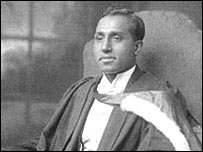 | Dr Satyenda Nath Seal practised in Barton Street in the early 1920s |
There is also a small minority of Sikhs living in Gloucestershire, often engaged in small businesses. The present Labour MP for Gloucester, Parmjit Dhanda, is of Sikh origin. The old Dowty Rotol and Smith's Industries factories attracted some Asians to work as engineers in the county. Others found employment in the Wall's ice cream factory in Barnwood and the ICI plant in Brockworth. According to the 1991 census, Gloucester City Council is the only local authority in the whole South West with a proportion of residents from ethnic minorities above the national average with 5.7 per cent. Bristol has the second highest concentration of ethnic minorities with 5.1 per cent. » See 'The Bangladeshi Community'
» See 'The Christian Community'
» See 'The Gujarati Muslim Community'
» See 'The Hindu Community'
» See 'The Pakistani Community'
» See 'The Shia Muslim Community'
» See 'The Sikh Punjabi Community' |