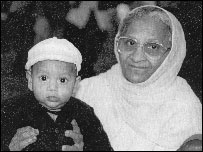
They came from towns, cities and even remote villages from Gujarat State in India. What kind of obstacles did they encounter? Most émigrés remember the harsh, frigid winters with icy roads, and fridge-freezer air. They coped with very different working conditions. There was no siesta or break during the day - just one long 8-12 hour working shift. Most laboured at the mills and factories of Lancashire and Yorkshire and moved often, to find work elsewhere. They were wanted as factory hands and labourers. Those with professional qualifications were informed they were not wanted. 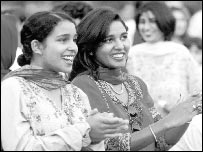 | Young women at an Asian event in Gloucester Park |
Gloucester boasted very little industry in the late 1950s and early 1960s and so many worked in hotels at first and transferred later to such companies as Williams and James Engineering, British Nylon (Du Pont, Brockworth) and Wall's Ice Cream. Many private and commercial companies candidly told job interviewees that they 'weren't hiring blacks'. It was quite legal to do so before the Race Relations Act criminalised such practices. In the absence of families and long-term friends, the men formed close friendships with their compatriots and joined together to purchase properties to use as flats and houses. Many landlords in the sixties would hang "No Blacks" signs in their windows. Thus the arrivals had no choice but to buy the properties outright to enjoy a roof over their heads. 
Some beds would actually never turn cold, as a daytime worker would vacate the bed for a nightshift worker in the morning. | | Our Untold Stories |
Some of the earliest men to arrive became known for leasing out rooms as temporary accommodation for new arrivals. Some beds would actually never turn cold, as a daytime worker would vacate the bed for a nightshift worker in the morning. It seems that there is a disproportional representation of Gujarati Muslims in Gloucester. But there seems to be a similar pattern of disproportional representation in most regions in Europe. For example, there is a Sikh majority in Hounslow, and mostly Hindus live in Leicester. This could be the result of colonial ties and also the fact that first arrivals would become contact points for later arrivals. As a result, if several Gujarati Muslims had established themselves at an early stage in Gloucester, later arrivals would find the path 'already beaten' and reap the benefits. A Muslim community has to abide by dietary protocols and Muslim butchers soon appeared. Similar to Jewish Kosher food, Muslim halal meat is obligatory for all. Today there are five major grocery-butcher's shops in central Gloucester that cater not just to Muslims but to any person who appreciates vegetables and spices not commonly found at regular shops and superstores. At first the men used empty rooms in their own homes as places of congregational worship, but soon banded together, raised funds and established mosques for their burgeoning communities. The two domed mosques in Gloucester today are difficult to miss but are quite recent additions. 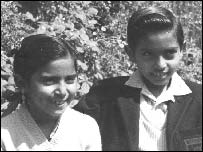 | Rashid Kholwadia and his sister Amina were the first Gujarati Muslim children to enter the educational system in Gloucester |
For decades, men prayed at nondescript buildings that had originally served as warehouses or TV rental shops. Later, the families joined the men and experienced the strange land of England from another viewpoint. Men experienced England from a working man's perspective. Wives and mothers saw England through a female prism. The children entered schools and came to know England from another completely different standpoint.
Men experienced England from a working man's perspective. Wives and mothers saw England through a female prism. The children entered schools and came to know England from another completely different standpoint. | | Our Untold Stories |
As bilingual children, the youth quickly adopted the norms and culture of their host country and thus wove between two foreign worlds, able at a moment's notice to switch from the dialect of an English borough to the idioms of a state many thousands of miles hence. Always conscious of being the 'outsider', young people kept a low profile and were often perceived as diffident, shy individuals. Teachers would often report them as 'model' students, perhaps because they were least likely to cause incidents in the classroom and because they were disciplined by parents to work hard at school. Discipline for youth was uncompromising. English schools then also used corporal punishment and it was certainly practised at the 'Madressah'; a school attended by Muslim children every evening after regular school. Nowadays, this form of discipline is outmoded, partly because of recent laws regarding child rights but primarily because second and third generation parents are less tolerant of excessive smacking and caning today. At the Madressah School, usually based in a room at the local mosque, children learnt to recite the Holy Koran (the Koran is to Muslims as the Bible is to Christians), to practise different forms of worship and to understand laws and scripture from books written by scholars and teachers. 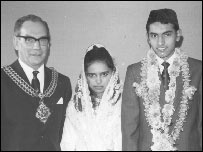 | Mayor Harry Worrall attended the first Gujarati wedding in Gloucester in 1972 |
The Koran is written in Arabic but children aren't taught Arabic grammar or even the meanings of words. Children are taught the sounds of letters and words which they learn to recite. Imagine reading this paragraph aloud but without understanding any of the words or the sense of the sentences? Recitation of the Koran is an important form of worship but some parents are addressing the Arabic language gap and attending Arabic classes with their children. A few Indian families in Gloucester speak Arabic exclusively to their young infants. After all, the language of the afterlife will be Arabic, so a 'headstart' is prudent. Fathers and grandparents didn't always come to England direct but often lived a generation in a third country as guest workers. Perhaps passage to England could prove to be too expensive. One source claimed Nehru, the Indian Prime Minister, prevented Indian citizens travelling to England because he feared they were being exploited by the colonial 'mother' which was making professional migrants undertake unskilled, low paid manual work. To avoid the barriers many men first obtained visas to a third country and then moved onto England. 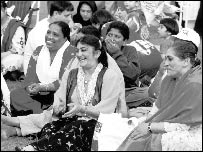 | Muslim wives and mothers have seen the UK through a different prism than their menfolk |
Our Untold Stories has found no data to confirm this but it is certainly how one person remembers it. Indian Muslims are a minority in England and a minority in India. Other nationals, such as Pakistanis, are gifted with a genuine homeland. Indians are conscious of being in the fringe, even in their parents' country of origin. Their parents and grandparents establish their roots during childhood through everyday memories of family and a sense of belonging to their homeland.
Younger community members, born in Europe, may visit the mother country briefly and may identify a few faces from family photograph albums. But the connection to the extended family is tenuous and there can often be a language barrier. | | Our Untold Stories |
Younger community members, born in Europe, may visit the 'mother' country briefly and may identify a few faces from family photograph albums. But the connection to the 'extended' family is tenuous and there can often be a language barrier. The young generation occupies a larger footprint in this country's industrial and commercial sectors than their forebears. Fathers and grandparents, confined to manual labour, dreamt of higher ambitions for future generations. Today, sons and daughters are employed as factory hands, IT Professionals, lawyers, doctors, architects and also self-employed as business-owners. More recently, adults and teenagers have joined the British Army, marking an enormous cultural leap. Would the Army allow the observance of prayers and sensitivity to dietary restrictions? The MOD has relaxed a number of regulations to encourage ethnic minority participation. The Muslim Territorial recruits enjoyed the Army experience without jettisoning their Muslim observances. One Muslim recruit is considering a full professional career with the Forces.
There has admittedly been an insular attitude stemming from the elderly generation and infecting the young men and women. However, the spirit of youth often dares to step outside the box. | | Our Untold Stories |
Invisible ceilings denying access to many job sectors have become porous. Sometimes the barriers are within. Young people have rarely participated as members of gyms or other leisure clubs. Membership costs can be prohibitive and even today there is an untapped fund of talent for certain sports. There has admittedly been an insular attitude stemming from the elderly generation and infecting the young men and women. However, the spirit of youth often dares to step outside the box. The elderly Asian population, though small, is increasing. Those who migrated during the 1960s were relatively young and are now facing old age in Great Britain - something for which they did not plan. The current elders did not envisage remaining in Britain permanently. Their objective was always to earn some money, and to try and improve the standing, conditions and circumstances of the extended family back 'home' in India. The emotional roots remained in India and still do, to this day. Growing old in a foreign country can raise the spectre of isolation and depression.
Men and women left all that was familiar in their youth and embarked on a voyage to ameliorate the economic standing of their families. They raised their own immediate families and established a quality of life for their sons and daughters unknown to themselves in their youth. They sacrificed with a purpose, and people on two different continents have reaped the benefits. | | Our Untold Stories |
National research has highlighted the low uptake of mainstream services, especially community care services. There are specific needs relating to language, culture, religion and tradition. The Asian Elders Drop-in Centre at Hatherley Day Centre and the Mainstream Day Care Provision at Great Western Court (managed by Social Services) respond to these specific needs. These elderly men and women left all that was familiar in their youth and embarked on a voyage to ameliorate the economic standing of their families. They cabled monies to fund buildings, amenities and to succour the general well-being of relatives. At the same time they raised their own immediate families and established a quality of life for their sons and daughters unknown to themselves in their youth. They sacrificed with a purpose, and people on two different continents have reaped the benefits. The present generation and generations to come owe a debt of gratitude to the courageous spirit of their elderly parents and one day, perhaps with the help of this history project, will recall the love and labour expended on their behalf. » See 'Mahmood Patel'
» See 'Ebrahim Surty'
» See 'Mahmood Moolla'
» See 'Salim Kholwadia'
» See 'Mohammed Hansdat' |