#smsldn: How Twitter does everything a journalist needs

Charles Miller
edits this blog. Twitter: @chblm
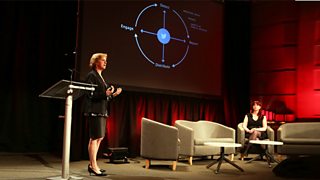
Vivian Schiller (left) and Joanna Geary
People ask why she made the switch to a social media business. She tells them that “something very profound happened to me… and that was Twitter.”
And if you want to know exactly what makes Twitter so profound, for journalists like Schiller, she has a PowerPoint to explain it.
As she sees it, Twitter has a contribution to make to every aspect of the journalistic enterprise. She breaks that down into four over-arching processes: detect, report, distribute and engage.
With the help of her British colleague Joanna Geary, head of UK news partnerships for Twitter, also a recent arrival from conventional news organisations (the Guardian and the Times), the Social Media Summit audience was given a tour of what they call the Twitter ‘news compass’ (below).
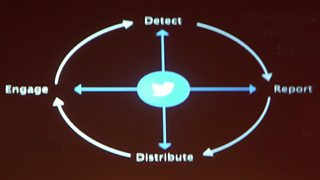
The Twitter compass
You can’t deny that Twitter’s a useful information-gathering tool. There are 500 million tweets sent a day. Schiller sees them as “goldmines for journalists”.
If an individual tweet usually doesn’t tell you much, you can put them together to identify trends: shifts in public opinion, patterns of reporting, viral content or ideas. And those are stories too.
The tools for taking an overview of tweets are increasing sophisticated. Geary talked about Dataminr, which, in partnership with Twitter, has access to all tweets and analyses their text to plot interesting results geographically over time, creating news alerts (although it seems Dataminr hasn’t yet mastered the art of adding sound to video):
The technology can create an animated timeline to show, for instance, the changing geographical distribution of #BringBackOurGirls as it gathered momentum.
Even the familiar TweetDeck can be a powerful way of pinpointing a story, said Geary, if you use the right filters - for example, a few related results from “expletive + collapse or collapsing” might reveal a story. That’s what Geary called “using TweetDeck aggressively”.
Report
Having gathered information, the second journalistic process is the reporting itself. That involves things like verification, the creation of a new piece of content that adds value to the original, and perhaps the acquisition of the rights to footage or photographs.
Again, Twitter is useful for these jobs. It’s a handy way to contact experts, or witnesses caught up in a news event, or to reach the producers of media that you want to include in your output. “We can get you within the last mile of the story,” says Schiller.
And there are specialist services like PicPedant, Geary added. It’s concerned with detecting any sly Photoshopping of images which might affect journalistic judgements about their origins or authenticity.
Distribute
Again, the role of Twitter is obvious: build followers, distribute something that interests them and the network will do the rest.
There’s also a chance to extend the value a sponsor gets from involvement with journalism.

Joanna Geary
This is social media, a conversation rather than an announcement. The right tone of voice will build brand loyalty and maximise sharing of the journalistic work you have done.
At #smsldn on 16 May, Geary showed a Twitter video about the work of Jon Henley, a Guardian feature writer and something of a self-confessed Twitter sceptic before a project in which he went to Greece to report on how people were coping with the financial crisis. He was overwhelmed by the response to his Twitter appeal for contributors, got some great stories, and built a Twitter following in a matter of days.
At a social media conference, Schiller and Geary were preaching to the converted, most of whom were already tweeting away happily as they spoke.
Nonetheless, the Twitter news compass is a neat way to nail the idea of Twitter as a proxy for every aspect of what a journalist needs to do - except, of course, for finding a way to get paid.
Videos of the sessions at #smsldn will appear on our YouTube channel in the near future.
