#smsldn: How to make highly shareable, highly clickable content

Mark Frankel
is BBC News social media editor. Twitter: @markfrankel29
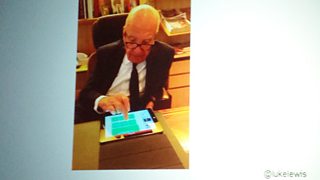
Shareable: Rupert Murdoch playing 'Which billionaire tycoon are you?'
They've never been afraid to fail at Trinity Mirror, according to Martin Belam of UsVsTh3m - provided they can also find something that works! He recounted an early experiment photo-shopping horses teeth into celebrity pics. "Nobody tweeted it and it was quickly abandoned." Few would dispute the success of UsVsTh3m, but are we all willing and able to learn through failure?
Of course Martin had plenty of examples of data visualisations that had proved engaging. A combination of timeliness, finding an emotional connection and providing a strong visual image were recurrent themes. The Ampp3d interactive on Wayne Rooney's earnings was one great example he shared; the graphic he produced on people who may have died building venues for Qatar 2022 was another excellent illustration.
It was important, he argued, to remember that "people don't share things in the rhythm of the newsroom" - or in any particular schedule. The numerous Facebook referrals and click-throughs they receive are often late at night (after pub closing time).
For Luke Lewis in the BuzzFeed UK office, nearly 50% of staff work on humorous content; others focus on news. But crucial for all of them is how their content works on a smartphone or tablet.
Luke shared a slide illustrating how the BuzzFeed CMS shows writers how their articles look on mobile. He also told us that 60% of views were via mobile. But when an article 'went viral' this leapt to between 80% and 90%.
Quizzes are more popular than ‘listicles’ for BuzzFeed. The success of a quiz has everything to do with how results are shared. Each writer at BuzzFeed has a dashboard showing "social lift" - how and where their pieces are being shared. The audience particularly enjoyed the example above of the quiz 'which billionaire tycoon are you?' Rupert Murdoch took it - and got himself.
We all know, deep down, that headlines can make or break our content. And that humour can make a big difference to headlines - as illustrated by the brilliantly titled '21 Pictures Of Politicians In Wellies Staring At Floods'.
Laura Oliver from the Guardian said she felt "very traditional" sitting between Martin and Luke. But the Guardian still had plenty to say. She told us that some Guardian pieces do well and continue to be shared and read over time. Laura told us that 'top five regrets of the dying' fell firmly into this category.
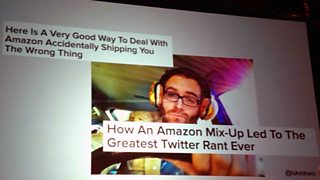
Good headline writing - Amazon
For Laura, good content, timeliness, human interest and knowing your audience are what counts. The key to success is to understand what motivates your audience and encourage them to become advocates for your story when they share it. Tapping into an existing community can also help - be it a part of the world or interest group.
She agreed with Martin and Luke about the value of a good quiz; about the need to keep experimenting; and about learning from failure as well as success. On the last point she pointed to the example of a piece about ink-marked fingers in India. Her team, she said, should have built up more of an audience in advance of publication, thought about launching it on social media rather than from the website, and, perhaps crucially, understood that the Times of India got there first.
The panel were asked whether they worried about producing too much click-bait content? Yes, they were conscious of the criticism, said Martin, but they strive to optimise content for different audiences at key times rather than push out multiple headlines on the same story at the same time.
If you could change one thing what would it be, asked one member of the audience? For Laura it would be processes - to ensure we never "compete against ourselves and always produce content that is as widely shared as possible”. For Luke it would be to build on an 'OK to fail' model. And for Martin it would be to insist that everyone did everything on and for smartphones - and to think more about marketing. He drew our attention to an interactive on the search for missing flight MH370. The data journalism, he said, was superb but the headline wasn't. So Ampp3d made an animated GIF with its own headline. "Everything," he argued, "starts with zero and you have to work for page views."
A member of the audience wanted to know how the panel could make money from shareable content? There was agreement that display advertising didn't deliver much. Martin said he was fortunate not to be asked too many questions about revenue-raising. For Laura it was essential to talk to key partners. And for Luke the answer was to focus more on sponsored posts.
So what about the future for shareable content? I'll leave you with a thought from Martin. He couldn't imagine the BBC fundamentally changing its approach to news. "But," he said, "the BBC's move into shareable infographics" (with the launch of #BBCGoFigure) meant it was important to "stay fresh”. We'll clearly need to revisit that question next year.
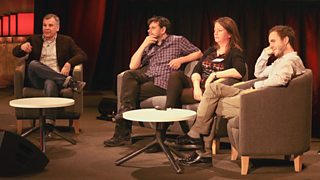
Shareability panel (from left): Aron Philhofer, Martin Belam, Laura Oliver, Luke Lewis
Videos of the sessions at #smsldn will appear on our YouTube channel in the near future.
