Translating money: A new tool for understanding between Chinese and English

Frank Ip
is a senior producer at the BBC Academy
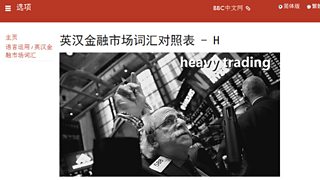
Chinese financial glossary page
It is the fruit of a long process of cooperation between the BBC College of Journalism's international language sites team and Chu Hai College of Higher Education, Hong Kong.
The origins of this unlikely sounding collaboration between two institutions on different sides of the globe can be traced to a conference in November 2013. It was jointly organised by the BBC College of Journalism and the Hong Kong Baptist University on the theme ‘independent journalism: language and impartiality’.
During our time in Hong Kong, my colleague Najiba Kasraee and I made use of a rare opportunity to visit another Hong Kong institution, the aforementioned Chu Hai College. We arrived at its Department of Journalism and Communication, exchanged views, and explored opportunities to work together.
One of Chu Hai’s lecturers, Sherman Li, mentioned a glossary he had prepared for use in teaching his students. It listed entries in English alphabetical order and gave details of how the respective terms are used in China, Taiwan and Hong Kong. Having discussed this a little further and shown our interest, Mr Li provided a copy to us immediately for consideration. We were greatly impressed by such generosity, which was the starting point of a project that has finally come to fruition almost a year later.
The glossary provides ready English-Chinese reference of financial market terms. Similar authoritative compilations are in short supply despite the fact that finance and stock markets are among the hottest topics for discussion at the moment.
What is more special is the fact that, starting with English, the glossary provides the Chinese equivalent as used in Mainland China, Taiwan and Hong Kong. It is perhaps not common knowledge that the three main constituent parts of so-called ‘Greater China’ actually have their own idiosyncrasies when it comes to specialised terms.
This could be the result of different practices but might equally be due to different ways of translating foreign terms. Whatever the case, as a result, the terms as used can vary greatly between these places. A glossary listing the different versions will be an invaluable tool to Chinese journalists, as a useful reference in the course of their daily reporting routine.
To further enhance the usefulness of the glossary, it is offered in both simplified and traditional Chinese versions, the former being the predominant form used in mainland China and the latter the standard in Taiwan, Hong Kong and most overseas Chinese communities. Users can choose the version they need by clicking on a button at the top of page, anywhere inside the glossary.
In the course of preparing the glossary for publication, Sherman Li, who devised the original version, completely revised and expanded it, enriching the offer tremendously. From terms on spreadsheets, work began to transform them into tables, easily displayable online. The process took time and effort, as it involved hard-coding html tables.
To enhance the work's appeal and impact, topics were selected from each alphabet, associated with suitable images and rendered as classy black-and-white pictures to use as index thumbnails and main images for the text body.
With close to 50 pages of glossary tables published, you could say we have reached the end of the long process. Not so. Plans are already afoot to expand on this, adding explanations to the terms.
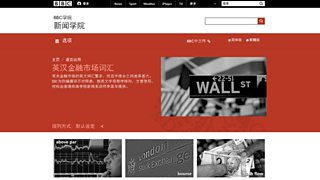
Chinese financial glossary
