Another competitor for news? Confessions of a Kindle convert

Charles Miller
edits this blog. Twitter: @chblm
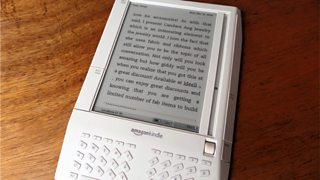
Original Kindle model
Bezos claimed to be a passionate fan of what he called “long-form reading”, insisting he just had a better idea about how to present text.
The first Kindle appeared in 2007, looking like the poor relation of an Apple product. Bezos had apparently over-ruled his designers, insisting on extra buttons on its white plastic exterior, making it more complicated than the simple, purpose-built reader his colleagues had intended.
Today’s top-of-the-range Kindle has only one button - to wake it up. Apart from that, everything is controlled through the touch-screen, which is used to turn pages, input text, buy books, make notes, adjust its brightness - even search the internet.
I know this because a few months ago I bought one. Of course there are plenty of rival e-readers around, such as the Nook or the Kobo, and indeed the original Kindle wasn't even first into the market. For me, the decision to go with the Kindle had more to with the endless ads on Amazon’s front page than any intelligent comparison of the merits of rival brands. I just gave in.
I also bought a fake-leather case for my new toy. I like to think it gives the impression of a wallet, or even an elegant leather-bound volume, rather than a gadget designed to consign books to history.
I’m convinced e-readers should be part of any discussion about the future of news: first, because Amazon says its users read more books than they used to - presumably reducing their time for news consumption; and, second, because I now read my Kindle when I would have previously been reading newspapers and magazines.
It’s a simple physical thing. A book on a breakfast table doesn’t sit flat in the way a newspaper or magazine does so conveniently. There’s no such problem with a Kindle. Just prop it up and reserve one marmalade-free finger to prod the screen and turn the page.
Similarly, on a crowded bus or train, you only need one hand. The device opens instantly at the place you stopped reading and you’re not going to drop your bookmark on the floor. Much easier than trying to read a newspaper.
I may still be in the honeymoon period but here are the other findings of this Kindle convert:
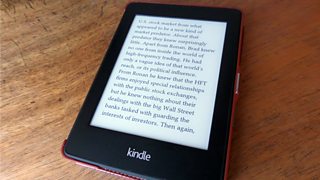
New Kindle
2. You can change the size, spacing and font to suit your eyesight.
3. Although Kindle books don’t have pages (because the number of words per screen depends on the text size you have chosen), you always know how far into the book you are as a percentage, and are even given an estimate of how many more minutes there are until you finish a chapter or the whole book. A whole paperback apparently takes about five or six hours at the rate I read. You can switch these figures off if they disturb you.
4. Instead of having to scribble in the margins, with a Kindle you can highlight passages with your finger and make notes about them using the Qwerty keyboard that pops up on the screen. The collected highlights and notes appear both on your Kindle and on an Amazon web page where you can copy and paste them into other documents. This cuts out the need to scour your book for pencil marks after you have finished it.
5. You can find out what a word or phrase means with the in-built dictionary, or see what Wikipedia has to say about it if you’re in wi-fi range.
6. There’s a feature called X-Ray which lets you see where a name appeared throughout a book. So, if you’re reading a novel and have forgotten who someone is, you can instantly jump to their previous appearances (though I have yet to work out how to get back to where you were in one move).
7. You can keep hundreds of books on an e-reader, which is comforting when you’re travelling: you’re not going to have to cart around a suitcase of books for fear of running out of reading matter.
8. Kindle editions are cheaper than print books. For the first two books I read on it, I saved £7.63 compared to the Amazon price for their paperback editions. At that rate I’ll only have to buy 20 more books to have paid for the Kindle.
9. The battery goes on and on compare to my tablet and mobile phone.
10. If you want a book, it’s fast. Yesterday, before leaving home, I read a reference to a new book I was interested in. A few clicks later it appeared on my Kindle and I was reading it on the way to work.
So that’s all good.
But I’m not a complete convert. Since starting to to use an e-reader, I have also enjoyed pulling an old paperback of my shelves, and appreciated the familiar experience of getting to the end of a chapter and turning the page to find the next one.
I enjoyed the slow fattening of the pages on the left, and the thinning of those on the right which were still to be read. I liked the slightly yellowed look and smell of it, and felt more of a connection with the writer than I do when reading a screen.
And I even still enjoy organising the sections of a Sunday newspaper. There’s a certain satisfaction in making a mess with them all and clearing it up again.
I shouldn’t get too sentimental about print. But I think there’s a rather more serious deficiency of electronic reading: I found it was harder to remember specific passages because on the Kindle you can’t visualise them at a particular spot in a double-page spread.
I now realise that when I want to go back to a paragraph in a book I can nearly always remember where it was on the page. I only need to search that area as I leaf back through to find it. With an e-reader there’s nothing like that to remember: every chunk of text is the same in every book. You only have a cerebral memory to fall back on.
And when you finish a Kindle book there’s a sense of anti-climax. You just click on another screen to read something else. The physicality of a completed book is a kind of trophy: the reader’s equivalent of the hunter’s antlers on the wall - even if only you realise that about your book.
So in the end I am a surprised convert with some reservations. Years ago I enjoyed the heft of War and Peace, but if I ever read it again I think I’d go for the electronic version. But still, as a treat, once in a while I will indulge myself in the physical pleasure of a nicely dogged-eared paperback or the perfumed delights of a fusty hardback.
Bezos was both right and wrong.
Charles Miller wrote about Amazon in connection with a documentary he produced for BBC Two earlier this year.
