Russia's journalists join wave of disillusioned emigrants

Stephen Ennis
is Russian media analyst for BBC Monitoring.
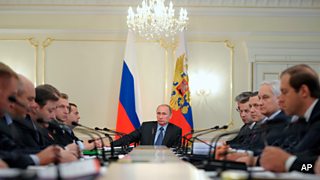
President Putin chairs a government meeting, March 2014
Modern Russian history has been marked by waves of emigration: from the left-wing revolutionaries in Tsarist times and the writers and artists who fled Bolshevik tyranny after the October Revolution, to the great brain drain that accompanied the collapse of the Soviet Union at the start of the 1990s.
The latest wave stems from the crackdown against the liberal opposition and independent media that followed Vladimir Putin's re-election as president in March 2012. A recent UN report notes that around 40,000 Russians applied for asylum in 2013 - 76% more than in 2012.
Among those packing their bags have been the former world chess champion and opposition activist Garry Kasparov, top economist Sergei Guriev, social media whiz kid Pavel Durov and several of the country's leading journalists.
One is Leonid Bershidskiy, who has worked at several of Russia's leading business publications including Vedomosti. In a post on Facebook in June, Bershidskiy recalled how he came back to Russia from university in the US in the 1990s with the hope of creating a "real press… the sort that in America publishes the Snowden revelations or in Europe stops ministers from getting away with misusing official credit cards". Now, though, he has admitted "defeat" and has gone to live in Germany.
For Bershidskiy, even reading in Russian or Ukrainian has become something of an ordeal amid the welter of "propaganda" provoked by the current conflict between the two countries. He now writes in English for the US business publication Bloomberg.
Alexandr Shchetinin, founder of the independent news agency Novy Region, currently lives in Kiev and has said he plans to renounce his Russian citizenship. The spur for this decision was watching Russian state TV - something he had not done in decades. "The more I watched the more I became convinced that nothing can be remedied here," he wrote in the Ukrainian magazine Novoye Vremya. "It will take generations to cleanse people's souls of the effects of this radioactive TV."
State TV has been active in creating a hostile atmosphere towards anti-Kremlin journalists. In August, Gazprom-Media's NTV aired films branding a number of public figures "friends of the junta" - an epithet for the Ukrainian government. Among the targets were writers and journalists Dmitry Bykov, Viktor Shenderovich and Andrei Malgin.
One of the Russian journalists who have been physically attacked because of their work is Oleg Kashin, a former columnist with the heavyweight broadsheet Kommersant. He was badly beaten up outside his Moscow home in 2010, spending several weeks in hospital as a result. Kashin now lives in Switzerland, where he moved in 2013 after his wife got a job there. He recently set up his own political commentary website, called simply Kashin. He calls it "partisan media" - sniping from the sidelines.
Emigres like Kashin and Bershidskiy have come under fire from some colleagues, such as former TV presenter Anton Krasovsky, who said they were guilty of "egotism" for abandoning friends and family.
But some journalists see emigration as the only feasible means to continue their career.
Galina Timchenko was sacked in March from her post as editor-in-chief of leading news website Lenta.ru after publishing an interview with a Ukrainian ultra-nationalist. She is developing a new website, called Meduza, to be launched this month from the Latvian capital Riga, with some of the finance coming from Russia's most famous current exile: former oil boss Mikhail Khodorkovsky.
Commenting on the decision to choose Riga as the base for the new site, Timchenko's colleague Ilya Krasilshchik told the Russian version of Forbes magazine: "It is simply the case at the moment that in Latvia it is possible to create an independent Russian-language media outlet, whereas in Russia it is not."
Timchenko and her team appear upbeat about the prospects of Meduza. But many emigre journalists express a sense of disappointment and disbelief at how Russian society has changed over the past decade and-a-half. "It is an emigration of disillusionment," Bershidskiy said.
College of Journalism’s Russian website
