Learning to shoot with the army - on Newsbeat’s most ambitious film

Matt Wareham
is a producer with Newsbeat
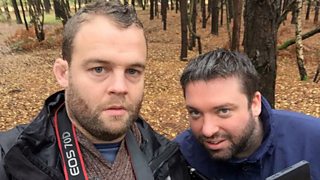
James Waterhouse (left) and Matt Wareham after a rainy night camping in the woods
Much like the recruits, when my colleague James Waterhouse and I rocked up to ATC (Army Training Centre) Pirbright on a drizzly day in July we didn't really know what the next 14 weeks would have in store. It's fair to say that initially some of the army instructors were, at best, apprehensive about us being there. The way a military instructor had been portrayed in a previous documentary series had made some of the training team anxious, and the idea of two 'civvies' being around throughout the entire training programme wasn't something everyone was comfortable with.
We’d agreed with Newsbeat’s head of visual journalism, Jonathan Blake, and the editor of Radio 1’s iPlayer channel, Sam Bailey, that the end result would be a 30-minute film. It was the biggest video project Newsbeat had ever undertaken, but to condense 14 weeks of training into 30 minutes was always going to be tough.
The last film I made was about people who used to be in bands; it was 15 minutes long and took four days to shoot. This was a different beast altogether: we found ourselves making a half-hour ‘obs doc’ with just two people, from around 25 days of shooting.
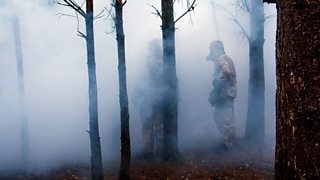
In the middle of a simulated gas attack on the final exercise
Turning the leanness of our two-person VJ (video journalist) operation into an advantage was key to making the film we wanted. We quickly built relationships with the instructors and recruits, and embedded with them as much as we could. Our biggest strength was being just ‘Matt and James’, who were there to film, rather than a production team who kept themselves at arm's length.
I firmly believe that the closer you get to your subjects the more intimate and personal you can make your film - and both the instructors and recruits seemed happiest and most relaxed when we got stuck in. Whether that meant sleeping in a tent in the woods next to their camp (a relative luxury given that the recruits were sleeping in a hole they’d dug themselves under a stretched tarpaulin) or eating ration packs alongside them, we tried to stay close without getting in the way.
From a production point of view the project brought some unique challenges. As there were only two of us we could only be, at most, in two places at once. We’d also agreed that we would only be there in a passive capacity and wouldn't interfere with the training programme. This meant no retakes if we didn't get quite the shot right or wanted a second angle. We quickly became well versed in using recruits other than those we were following for cutaways, and using GoPros to capture action in places we couldn't be.
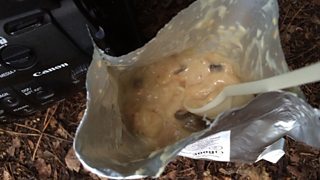
Apparently better than they used to be, army ration packs are about as tasty as they look
Being a BBC News team had already been a help as the Ministry of Defence were able to give us a bit more freedom than a factual or documentary crew would get. But midway through the training we found ourselves having to quickly turn into full news mode: a female recruit, Megan Park, had died at the camp after collapsing whilst taking part in a run during her first week of training. None of the recruits we were following knew her, but nonetheless as the mood of the camp became more sombre we found ourselves right in the thick of a breaking news story.
We had no broadcast kit with us, so Luci Live on my phone came to the rescue. Within a few minutes of a statement from the army being released, James had filed a piece for the next Radio 1 bulletin and was doing a live two-way on Radio 5 live, before later filing pieces for Radio 2 and Radio 4.
The filming for this doc took us everywhere from Sandhurst, to Belgium, to the Brecon Beacons, but it wasn't until after filming had finished that the intensity really ramped up. We had around three weeks to turn it around, and with such a vast amount of footage it was always going to be a tough task to cut.
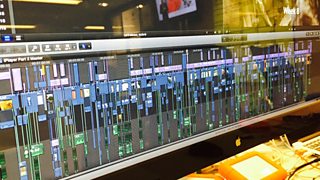
Ready for delivery...the final project was the biggest and most complicated we'd ever cut
In keeping with our lean approach, I cut the film in Final Cut Pro whilst James concentrated on the additional online pieces for the Newsbeat website and a news piece that ran on BBC Breakfast and the News Channel on the day it went live.
Being a ‘digital first’ film, we had to think about how to sell it online from the start. I'd cut a 30-second trail that went up on social media the week before, and that set us off to a good start by reaching over a million people on Facebook alone. After the initial promotion using that trail we used short clips from the doc to help sell it more specifically and to keep the posts looking fresh. Radio 1 and BBC Three were both helpful in sharing our content to audiences with the right demographic but who might not be following us.
It was a lot of work, especially towards the end, but having seen the audience interaction and shares on social media – as well as holding on to a place in the iPlayer top 10 for most of the first 24 hours after launch - the signs were that it was doing well.
It also had three TXs on the BBC News Channel across the first week and a cut-down version ran on the Victoria Derbyshire programme, so whilst it was always made with an online audience in mind, the film had also been able to reach linear TV audiences as well.
It was without a doubt the most ambitious film Newsbeat has made, and of course there were moments late at night staring at a screen when I genuinely wondered if we'd bitten off more than we could chew. But in the end, by approaching the production in a different way we were able to do what we set out to and capture an intimate and raw window into what it's really like to join the army.
Civilians to Soldiers is on the BBC iPlayer until 6 January and on the Newsbeat YouTube channel.
