Call that a story? No, it’s content marketing

Charles Miller
edits this blog. Twitter: @chblm
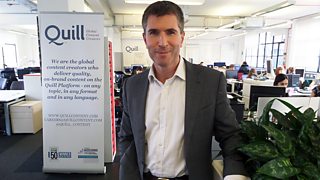
Ed Bussey, founder and CEO, Quill
While traditional media companies often struggle to make money in the mobile, online world, it may not be all bad news for the artists formerly known as reporters and film-makers. In fact there's a new way to earn a crust by generating content, thanks to something called content marketing.
I met serial entrepreneur Ed Bussey to learn about his London-based business Quill, which commissions content from freelance writers, film-makers and photographers and sells it to companies which want to communicate with their customers outside the confines of advertising.
So why should a company pay for content instead of just placing ads around traditional editorial offerings? Well, Bussey’s believed in the value of content since he joined a start-up 10 years ago. Figleaves.com sold clothes and competed with traditional retailers by offering more products than any high-street shop could carry. But Bussey noticed that, while up to a point more products meant more sales, above a certain level the effect tailed off and actually produced fewer sales. Marketers call it ‘the paradox of choice’: too many options leave potential customers bamboozled. The chances are they’ll give up and go away.
However, if you keep them engaged by offering something relevant that they’d like to read or watch inside the same commercial environment, you may still make a sale.
It was Bussey’s bet in starting Quill three years ago that commerce would embrace content in a big way. If he could offer companies content that helped customers make what he calls “better buying choices”, he could maybe grow a business from that.
The idea fitted happily with other trends: social media was offering a way for brands to engage with customers alongside personal messages in their timelines; a growing multiplicity of devices meant that distributing online content became more of a science, to make the same content work well on different devices. And the size of a mobile screen favoured content because it didn’t lend itself to separate editorial and ad spaces in the way that websites on a computer had.
Finally, when Google introduced the ‘Panda’ update to its search algorithm in 2010, sites which didn’t offer content that was frequently refreshed found themselves downgraded in Google’s rankings. A comprehensive but largely static inventory list, for instance, disappeared down the search results, while sites with fresh content moved up.
Quill hopes to benefit from a shift of ad budgets into content creation, driven by all these trends. To respond to the need for content, “companies are churning out a lot of rubbish,” says Bussey. As a dedicated content provider, Quill aims to do better.

Quill's website
So how does it work?
Well, Quill has a staff of about 30 in London, with about 2,000 freelance writers, editors, designers and photographers on its books, in 17 countries. Everything that’s produced is checked by staff editors, assisted by Quill’s own automated quality-control software. For instance, big companies often have lists of several hundred words which are deemed ‘off brand’. The software makes sure none of them slip into an article. And each freelance piece is rated for the number of edits and changes required, and the writer’s chances of getting future commissions are affected by the amount of work needed.
Here’s the kind of thing that comes out of the process:
“It's official: a trip to the village grocery shop is now a thing of the past. With supermarkets dominating the high street and the growing power of the world wide web, it's getting even harder to find fresh local produce and to know exactly where your food is coming from.” (From Money Dashboard)
“Business in Brazil is booming. The countries’ GDP is the 7th largest in the world, and its scale of manufacturing and industry is staggering. Alas, the country may boast impressive returns in a familiar industrial economy, but its service industry is still young, and incubators designed at fostering startups are still in their infancy.” (From Entrepreneur Country)
“Sugar is highly addictive and lurks in all sorts of unexpected places, like white bread, barbecue sauce and cereal bars, making it easy to eat more than the RDA of 90g. When we eat sugar, our body releases serotonin (also known as the ‘happy hormone’) which makes us want more – the trouble is, that sugar is converted into fat within the body.” (From LA Fitness)
You might find Quill content in your Facebook feed if you ‘like’ a business. You might find a link to it at the bottom of an article on a newspaper website, under ‘More stories from the web’, or something similar (placed there by content-discovery businesses like Taboola or Outbrain). And you’ll see it on company websites, which are becoming more like magazines than catalogues.
But is it journalism? Bussey doesn’t make any big claims: Quill content producers are “typically not doing journalism”, he says. But the jobs that Quill farms out range from the apparently journalistic (things like ‘London’s top five bars’) to straightforward copywriting jobs (an accurate product description of a new mobile phone).
Bussey says about one in five of his freelancers are journalists or bloggers. The rest are copywriters, often specialists in different areas such as legal, travel or sports. The skill is to get the right tone of voice for each company. Each job is priced separately, but it doesn’t sound like there’s easy money to be made: Bussey says a writer of product descriptions could expect something like £7 to £10 an hour.
I asked Jane Singer, Professor of Innovation Journalism at City University, whether she would count Quill’s output as journalism. “It sounds like some of it might be journalistic,” she said, “but it’s a grey area.” It might also be classified as marketing, publicity and a whole range of things – even if it is still factual, accurate and not misleading.
As a career move for a struggling freelancer, “I don’t think it’s inherently a bad thing,” Singer said. One test for her would be whether the reader of the material is being deceived about what they’re reading – but she said that would be more the responsibility of the client in how it uses the material, rather than an issue for Quill or its contributors.
Quill is “quite disruptive”, says Bussey, and, as the business expands into video production and launches its own content platform in January, that disruption looks set to grow.
Journalistic purists may see the idea of writing or filming for Quill’s clients as an insult to everything they’ve learnt about journalistic independence and impartiality. But Quill isn’t pretending to be anything it’s not, and Bussey insists his clients “don’t want their editorial integrity to be compromised”.
Of course the idea of creative content commissioned directly by companies which want to be associated with it is nothing new. Without it, we’d never have had soap operas.
