The boom in tech journalism - and its complex relationship with PR

Charles Miller
edits this blog. Twitter: @chblm
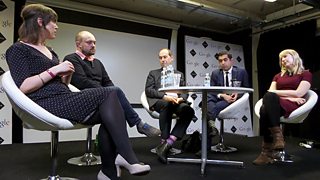
From left: Ruth Barnett, Tom Price, Rory Cellan-Jones, Murad Ahmed, Olivia Solon
That was the background to last night’s Media Society discussion about how the media covers technology. It offered a glimpse behind the scenes into the lives of tech journalists - exploring, in particular, their sometimes fraught relationships with tech PR and communications people.
On the PR side, Tom Price, head of UK and Ireland communications for Google UK, said that his idea of a good day was to be able to spend 100% of his time on proactive PR - taking stories to the media - and none on reactive.
But even when he found himself in a confrontational encounter with a journalist it didn’t have to be bruising: “The best journalists are always polite.” He tries to remind himself that when journalists disagree with his position it doesn't necessarily mean they don’t understand: they may just have a different view. “Accepting disagreement... is the way forward.”
From the evidence of the journalists on the panel, tech PR people have been having a bad week. Murad Ahmed, European technology correspondent for the Financial Times, admitted that when he urgently needed a quote from Facebook in relation to the Lee Rigby story “I called the two people I know at Facebook repeatedly for 15 minutes.” They didn’t answer, but at least it meant they wouldn’t be able to use their phones and maybe talk to other reporters.
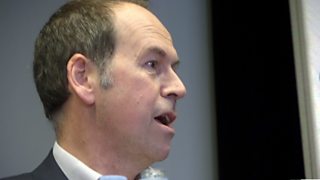
Tom said he didn’t like being called about a story very late just so a last line with his company’s comment could be added at the bottom of the page.
When it comes to Tom’s proactive PR, Olivia Solon, technology editor for Mirror Online, sounded as though much of the effort is wasted. She said that in the job she recently left at Wired.co.uk she used to get 500 emails a day from people wanting to be featured. She reckoned that fewer than 10 were “of any value” and that “not many stories come from a press release." One of the advantages of changing jobs was that most of those people don’t have her new email address.
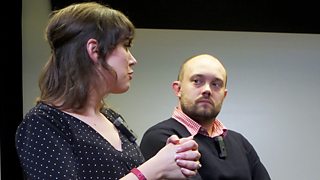
She now knows those perceptions are wrong and is surprised to find she’s doing as much writing as she did as a journalist. One of her frustrations is that to get news about her company out it always needs to be from a human perspective, rather than about how SwiftKey is actually a sophisticated artificial intelligence (AI) business. But it’s hard to sell stories about “the clever stuff we do".
Similar frustrations were evident among the journalists, too, in selling stories to their own editors, and in the assumptions they were asked to make about the levels of knowledge and interest among the audience. Rory remembered when he wasn’t allowed to refer to broadband without a tortuous explanation every time: “The language problem is a huge problem to me every day.”
In a previous job, Murad was told that every tech story needs to be understandable to “the granny in the shires”. This meant that on one occasion, when he was writing about Spotify, he was told to include a line to explain “how the sound comes out of a computer”.
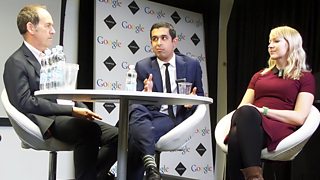
Ruth talked about a “reinvigorated technology press”. There are new online tech news services and social media that offer chances to get the message out beyond the traditional media world.
But sticks and carrots are still used by PR people to try to influence media output. Murad complained that some companies “will shut down any kind of communication with you if you don’t paint them in the best possible light".
When it comes to incentives, Rory thought it was likely to be the smaller media outfits which were more likely to be swayed by the offer of trips and other freebies. Personally, he found his annual (BBC-funded) trip to Las Vegas for the big US electronics fair CES “a living nightmare”.
Murad said the FT doesn’t accept any free trips or gadgets, but he’d recently talked to a journalist who’d accepted a trip just because of the promise of travelling business class. And Olivia said that for some game companies the permitted date of publication of a review depended on the number of stars the game was given.
But is the media covering the big, but slower, story of how tech is dramatically changing society as well as the smaller skirmishes?
Tom said you would be able, in future, to point to the seminal stories in politics, but he wasn’t sure if that was the case in technology. Rory admitted it was difficult for him to get airtime for “the important stuff that doesn’t have a big headline attached to it". There was the tyranny of the “case study” - someone doing something, which is the standard way to lead into a bigger story or issue. That was a requirement for “any story on the Six”, he said.
Olivia added that at Trinity Mirror “the human side is a massive priority”.
Technology correspondents are having a good run. So much so, said Murad, that in future the tech editor could be as important as the political editor. Or maybe there’ll be no tech specialists at all because tech will just be part of everything.
That was Tom’s view too. Coming from the man from Google, on a panel in London’s Google Campus, which was hosting the event for the Media Society, it would have been rude to disagree.
Media and Tech was produced for the Media Society by Charles Miller and John Mair.
