Election explainers to make your campaign coverage go with a swing

David Cowling
is editor, BBC Political Research
In research conducted by the BBC in 2012, 40% of people said they would be confident enough to explain the term ‘turnout’ to a friend. Thirty-five per cent said the same about ‘referendum’, 34% about ‘constituency, 27% about ‘by-election’ and 22% about the term ‘swing’. Here I’ve tried to define these (plus ‘coalition’) as simply as I can. Wish me luck with ‘swing’…
Turnout
Only someone whose name appears on a register of electors (compiled by local councils in Britain and by the chief electoral officer in Northern Ireland) is allowed to vote in elections. Turnout at any election is the number of electors on those registers who take the trouble to vote at polling stations, or by post or by proxy. If there are 50,000 names on a local register of electors and 25,000 of them vote, the turnout for that election is 50%.
Turnout varies considerably between different types of elections and between different areas at individual elections. Turnout in the UK in the 2010 general election was 65.1%, as a result of 29,687,604 votes being cast out of the 45,597,461 names on all electoral registers. Within that 65.1% national average, the highest turnout (77.3%) was in Renfrewshire East constituency, compared with 44.3% - the lowest - in Manchester Central.
Constituency
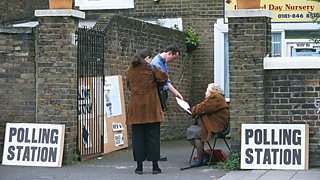
A parliamentary constituency is the area represented by an MP elected to parliament by the votes of people on the register of electors for that area. There are 650 constituencies in the present UK parliament: 533 in England, 59 in Scotland, 40 in Wales and 18 in Northern Ireland.
Since 1944 it has been accepted that parliamentary constituencies should be reviewed regularly to try to ensure that each one contains broadly similar numbers of electors. There were five major reviews between 1944 and 2010 when the boundaries covered by some constituencies were altered to take account of increases or decreases in numbers registered to vote in the area. (The last general election when significant changes to constituency boundaries were introduced was in 2010.)
The Coalition government proposed the most far-reaching ever set of changes in the sixth major review begun in 2011, but its proposals were shelved when the Lib Dems withdrew their support.
In terms of area covered, rather than people on the electoral register, the largest constituency in the UK is Ross, Skye & Lochabar (more than 2 million acres) and the smallest is Islington North (1,800 acres).
Coalition
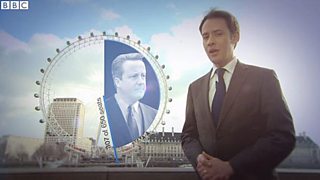
In the UK we’re used to general election results where one party ends up with more MPs than the number of MPs from all other parties combined, thus allowing the winning party to govern on its own. Coalition (explained using graphics, above, by BBC Political correspondent Ross Hawkins) is when two or more parties join together to form a government because no single party has enough MPs to govern alone. Coalition governments have also been formed, even when a single party has a majority, in order to respond to national emergencies, such as during the First and Second World Wars.
The present Conservative-Lib Dem coalition was formed after the 2010 general election because the party with the largest number of seats - the Conservatives - were still 21 seats short of a majority over all the other parties. It was the first peacetime coalition government since 1931.
Because Westminster coalitions are so rare, the past five years has been an education for all of us. The main features of the past five years have been: dividing up ministerial jobs between the coalition partners; joint negotiation over what laws the government introduces; compromises over voting for each other’s policies; and maintaining their political identities while also supporting coalition government.
Referendum
The reference book Brewer’s Politics describes a referendum as “a ballot in which the voters of a nation or region give a binding decision on a particular aspect of policy which their government feels unable to determine itself”.
The first-ever UK-wide referendum was held in 1975 when voters were asked to decide whether Britain should remain in the (then) Common Market, and 64% answered ‘yes’. The only other UK-wide referendum was held in 2011 when voters were asked to decide whether the Alternative Vote system should be introduced, and 67.9% said ‘no’.
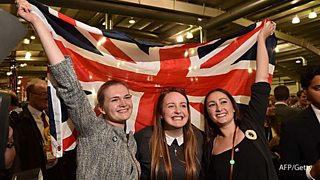
Scotland has held three referendums, one of which, in 1997, endorsed the restoration of a Scottish Parliament; and another, in 2014 (above), rejected independence. Wales has also held three referendums. One of these, in 1997, endorsed the creation of a National Assembly and another, in 2011, supported the Assembly being granted law-making powers. Northern Ireland has had two referendums: in 1973 a majority voted in favour of remaining part of the UK (although many boycotted the vote); and in 1998 a majority endorsed the agreement reached in multi-party talks (popularly known as the ‘Good Friday agreement’).
In addition, there was a referendum in the North East region of England in 2004 where the proposal to establish a regional assembly was defeated. And, in 1998, Londoners voted overwhelmingly in support of the creation of a Greater London Authority. In the 2015 election one of the issues in the campaign will be whether there should be a future referendum on the UK’s continuing membership of the European Union.
By-election
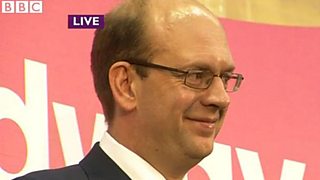
All types of elections in the UK are held on a single day and the people elected at the time are expected to serve for a fixed term: five years for the Westminster and European parliaments and four years for all other elected bodies. Occasionally, through death or resignation, vacancies occur and these are filled by holding one-off elections called by-elections. (The victory of UKIP’s Mark Reckless, above, in the Rochester and Strood by-election last November was one of the more memorable outcomes.) The person elected in a by-election serves what’s left of the term of office of the person they replace rather than a full four or five years.
By-elections for local council seats are held on most Thursdays of every year. The number of Westminster by-elections varies from parliament to parliament. In the 18 parliaments since 1945, the greatest number of by-elections (62) occurred in the 1959-64 parliament, and the smallest (1) in the February to October 1974 parliament.
In elections using proportional voting by party lists, such as those for the European Parliament and list seats in the Scottish Parliament and Welsh Assembly, vacancies are filled by the next person on the list rather than by a by-election.
And, finally, swing
In his book Brewer's Politics, journalist and broadcaster Nicholas Comfort describes swing in the following terms: “The statistical measure by which the switch of voters from one party to another on a national or constituency basis can be judged. It is calculated by adding the rise in one party’s vote to the fall of the other, and dividing by two. Thus if the vote of party A rises between elections or opinion polls by 3% and that of party B falls by 2%, there is a 2.5% swing from party B to party A.”
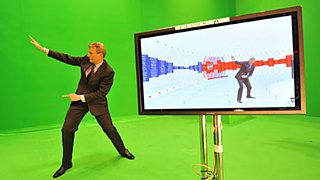
Swing (ably demonstrated in top image by BBC presenter Jeremy Vine, on election night 2010) is often used either to show the scale of the challenge that one party faces in winning an election or to measure the size of the shift in voting from one party to another in any particular result. In the 2015 election, the Conservatives need a swing of 2% to them in order to win an overall majority of MPs in parliament: Labour needs a swing of 2% to them to become the largest single party in a hung parliament; and a swing of 5% to gain an overall majority.
This is a slightly edited version of a pre-election briefing David Cowling has given to BBC News journalists.
Election terminology explained, because we don’t all speak ‘Westminster’
Our other blogs by David Cowling
This election will be complex, simple, social. So how do we cover it?
#GE2015: Polling has never been nearly this social
Reporting UK politics: Nick Robinson
