Election terminology explained, because we don’t all speak ‘Westminster’

David Cowling
is editor, BBC Political Research
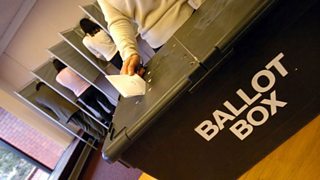
I have recently been listening to new research which reveals worryingly large numbers of people do not understand terms that many of us use regularly throughout election campaigns.
During the final week of the 2010 election campaign, 91% of UK adults consumed some part of the BBC’s election coverage alone. In general election campaigns, millions of people who do not normally follow politics in the same way as our more dedicated audiences are drawn into the somewhat arcane world (to them) of politics and elections.
Yet now research suggests that only about one in five people feel confident they could explain the term ‘first-past-the-post’ to a friend; only 40% are confident about explaining the term ‘Opposition’. We also know from a study by the Hansard Society in 2014 that three-quarters of people could not name their local MP.
In what follows I have had a stab at trying to explain, as simply as I can, four basic terms: election deposits, manifestos, first-past-the-post and marginal seats.
I hesitated to offer these definitions because they trespass on basic journalism, and I am not a journalist. However, if nothing else they may serve as a reminder that many of the people who will watch, listen and read election output in the coming weeks do not speak ‘Westminster’.
Election deposits
If you decide to stand as a candidate in the general election this May, you can only do so if you hand over a sum of money to the local returning officer along with the papers nominating you as a candidate. You get your money back if you receive above a certain share of the votes cast in the parliamentary seat you are fighting. If you don’t reach that number of votes you never see your money again - you have ‘lost your deposit’.
The system of deposits was introduced in the 1918 general election when the sum of money you had to pay to be a candidate was set at £150 (that was about £4,500 at today’s prices). The share of the vote you had to receive to ‘save’ that deposit was 12.5% - at least one in eight of the votes cast.
That £150 deposit per candidate remained unchanged for almost 70 years until the 1987 general election when it was raised to £500. But at the same time the share of the vote you needed to get your money back was reduced to 5% - at least one in 20 of the votes cast.
In the 2010 general election almost half of all candidates - 1,893 - lost their deposit, which meant the government received £946,500 to help pay towards the £113m cost of running that election.
Party manifestos
The word ‘manifesto’ comes from the Latin to ‘make public’ and a political manifesto is a document published at an election setting out the policies a party intends to follow if it wins.
The late Labour politician Peter Shore described manifestos as “a party’s contract with the electorate”. He didn’t mean a legal contract - rather a moral contract where politicians pledge that if people vote for them and their party they can expect promises made in that party’s manifesto to be kept. Manifesto promises therefore have a special status for politicians and civil servants.
A lot of the anger the Liberal Democrats faced after the last election was because they voted to increase student fees when in their election manifesto to voters before the 2010 election they had promised to abolish them.
And manifestos have changed over time. For example, in the 1900 general election the Conservative manifesto amounted to 887 words and contained (at a stretch) four promises. The 2010 Conservative manifesto involved 27,800 words and 620 promises.
First-past-the-post voting system
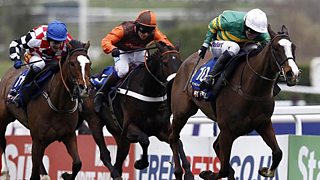
In a horse race, however close the horses are to each other at the winning post, only the one with its nose ahead of all the others wins. So it is in our Westminster general elections. It does matter whether you win by a mile or the skin of your teeth, so long as you have at least one more vote that the candidate in second place you are ‘first-past-the-post’ and elected.
The aim of some voting systems is to deliver broadly the same share of MPs in parliament as the share of votes their party receives at any general election. So if a party receives one in five of all votes cast then, broadly, they should end up with one in five of the MPs in the parliament. First-past-the-post voting is not designed to deliver such a result: its sole purpose is to produce 650 individual MPs, elected because they have more votes than the candidate in second place.
In the 2010 general election the MP for Liverpool Walton was elected with a lead of 57.7% (19,818 votes) over the candidate in second place. In the Fermanagh & South Tyrone constituency on the same day, the MP was elected with a lead of 0.01% (four votes). Regardless of the great difference in the size of victory between the two results, they were absolutely equal in one respect: both MPs were first-past-the-post in their constituency.
Marginal seats
The great majority of parliamentary constituencies do not change party allegiance in elections. Therefore, although there will be 650 individual contests in the 2015 general election, the outcome will be determined in a much smaller number.
In 12 of the 17 general elections since 1950, fewer than one in 10 seats changed hands from one party to another. Even in the massive Labour landslide of 1997, with its extraordinarily large swing of support from Conservative to Labour, 70% of seats stayed with the parties defending them.
The killing grounds in any general election, where governments are made or broken, can be found among that minority of parliamentary constituencies - marginal seats - with a history of being won or lost by parties.
There is no fixed definition of a marginal parliamentary constituency: but reasonably safe ones would be those seats where the winner leads the candidate in second place by a margin (called a majority) of up to 10% of the votes cast in the seat. By that definition there are currently 194 such marginal seats in Britain - around 30% of the total - and it is mostly among this relatively small number of constituencies that the future government of the UK will be decided.
This is a slightly edited version of a pre-election briefing David Cowling gave to BBC News journalists.
This election will be complex, simple, social. So how do we cover it?
#GE2015: Polling has never been nearly this social
Our other blogs by David Cowling
