How BBC News covered Indian elections on WhatsApp and WeChat

Trushar Barot
is BBC World Service apps editor @Trushar

Indian election celebrations.
We were the first major news organisation to try out editorial content on these platforms, so we were very much venturing into unchartered waters. Rather than setting targets for subscribers or audience reach, we used these pilots as proof-of-concepts to see if there was an appetite for these editorial products from users on these platforms. So how did they go, and what are some of the lessons we’ve learnt?
The Indian election
On WhatsApp we set up a BBC News account and invited users to add a mobile number to their WhatsApp contacts and send a message to it to subscribe to the service. Users were then put on to a ‘broadcast list’ where they would receive a maximum of three updates a day, in both Hindi and English.
We posted a variety of items. These included audio and video clips and daily text headline bulletins:
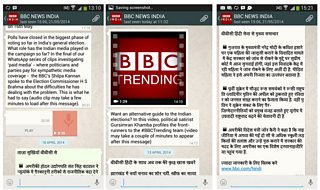
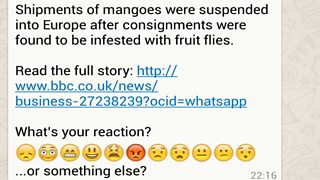
We also published ‘infographics’ of the electoral map of India, ‘fact-a-day’ images and bespoke text, picture and video entries from our correspondents across the country.
On election results day we upped the frequency of our posts to a live breaking and analysis service, where we ended up posting more than 20 items on the day.
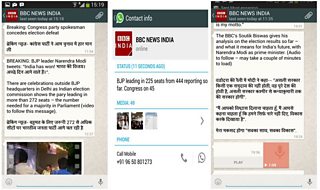

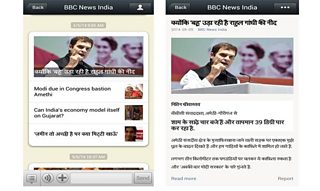
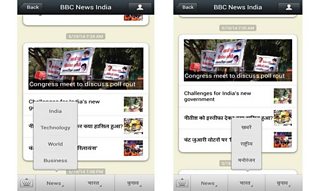
In addition to WhatsApp, we had set up a BBC News India channel on WeChat. This was limited to one update a day, where users would get a bundled set of headlines and stories that they could click through to, eventually taking them back to our News website if they wanted to read about the story in more depth:
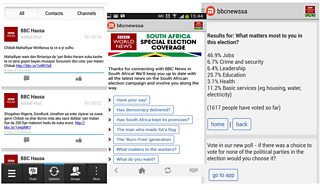
Also in Africa, we ran a two-week pilot on the popular South African app Mxit. It is primarily used by young South Africans - an audience we were keen to engage with on the election. It’s a platform that was built for feature phones, so the content was again very text-heavy. We were able to take account of interactive features like polls.
What we learned
For all of the services we tried out, the response from subscribers was very positive. Many said that they felt it was a more personalised experience. They also liked the immediacy of having the content pop straight up on their phone, but wanted more ability to choose what content they received.
In terms running these pilots, in most cases we were able to incorporate the extra content activity within existing social media team workflows. WeChat, BBM and Mxit all provided desktop versions and administrator tools to make it easy to post content and manage audience responses. They also provided some basic statistics to help us measure audience growth and reach.
The exception was WhatsApp, which doesn’t have a desktop version or any statistics available beyond knowing how many people are on your broadcast list. All of the editorial activity - content creation, publication and audience engagement - had to be done via a mobile phone handset. This took a lot more time, although it also seemed to be the platform that offered the most direct engagement with the audience.
Over the next few months we’re hoping to further develop our work on these and other instant-messaging platforms. From what we’ve done so far, there clearly seems to be potential for news content within these services - as long as the content is interesting, relevant and matches user expectations.
If you tried out any of these services yourself, I’d love to hear your feedback.
BBC College of Journalism blogs by Trushar Barot
Safety with user-generated content
BBC College of Journalism’s Hindi website
BBC College of Journalism’s Hausa website
