A down-to-earth look at how the internet actually works

Charles Miller
edits this blog. Twitter: @chblm
Book review: Tubes: Behind the Scenes at the Internet, by Andrew Blum
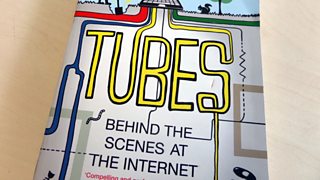
If you spend much of your working and home life online, maybe a summer break, stepping away from updates and emails, is a chance to learn how what you take for granted every day actually happens.
For instance, where is the internet?
In ‘the cloud’? Even in pre-cloud days we were already thinking about ‘uploading’ and ‘downloading’, which also subliminally suggested a kind of celestial home for our bits.
In reality, of course, there is no ‘up’ or ‘down’ involved. And there’s no cloud either. In fact the most ‘cloudy’ part of the internet is the bit right next to us: between the device we’re using and the wi-fi box, where data jumps mysteriously through thin air.
Mostly, from there on data travels through implausibly thin wires bundled together in cables, running for thousands of miles. They often lie on the sea bed, emerging on shore to link endless banks of servers on which data sits quietly until it is summoned by an online request.
It’s a modern miracle: both that the infrastructure has been built - much of it consisting of banks of cheap computers wired together - and it is so unbelievably reliable.
Andrew Blum wanted to tell the story of what actually happens on the internet - from his home connection right through to the under-sea cables and the internet exchanges where different networks meet and communicate. Somehow, both the companies which sell us the devices and the ones that make it possible to go online don’t particularly want us to know about this side of the business, and, frankly, it’s a bit geeky for most people anyway.
I suspect that neither companies or customers want to focus on the fact that, according to a Greenpeace report, data centres now consume 2% of the world’s electricity. Well, just because you like a restaurant it doesn’t mean you want to know what happened to the food before it turned up at your table.
The book's research is impressive, zeroing in on the very first transfer of data between two remote computers, orchestrated by a young prof at UCLA, Leonard Kleinrock, in 1969. Kleinrock was key to the development of 'packet switching': the way data is broken down into small chunks for transmission down the line and then reassembled at its destination.
The author meets up with Kleinrock and they even manage to find the machine on which that first internet signal was sent. It’s sitting neglected in the corner of a classroom at UCLA.
When the two of them sneaked into the room: “No-one even glanced at us. Kleinrock was one of the internet’s earliest masterminds, but to the 19-year-olds in here, whose lives were fully shaped by its presence - Internet Explorer came out before they learnt to read - he faded into the woodwork.”
Blum also shows how the internet pops up physically in the most unlikely of places - such as the village of Porthcuno in Cornwall. Here British transatlantic cables disappear unobtrusively into the sea. Porthcuno has been an important jumping off point from these islands since the days of the first under-sea cables.
If you happen to find yourself on holiday in Cornwall this summer, searching for the spot where so much of your data leaves dry land might make an interesting change from building sand-castles.
