New online formats: What I learnt from my audience

Charles Miller
edits this blog. Twitter: @chblm
On this blog a few months ago, I wrote about how I made an interactive video for the BBC Taster site. My project, called How to Succeed in Business, used Touchcast software to combine new footage of a startup incubator with interactive elements which were interview clips from documentaries I’d made about big businesses. The idea was to show how business leaders like Bill Gates and Mark Zuckerberg dealt with issues such as finding the right idea and picking a team, which all businesses, large or small, have to face.
The way the Taster site works is that each experimental project is up for a few months during which the audience is invited to give feedback. From that, the Taster team learns what works and what doesn’t in the new formats they’re trying out.
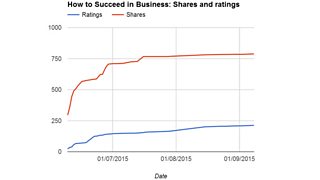
Well, my project’s time just came to an end so I’ve been looking at what kind of feedback it was given by the 216 people who passed judgement. Together with the stats about how the site had been used, there was some good news, some bad, some predictable and some unexpected.
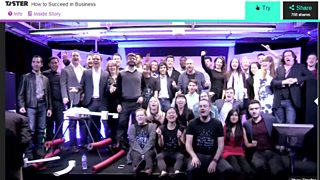
The incubator group from How to Succeed in Business
Here’s what I found interesting:
- Bad news: only about a quarter of the audience used the interactive elements - the footage you could choose to click on. If you didn’t click, you’d just be watching the story of the startups which lasted for about ten minutes. I like to think that was so compelling that nobody wanted to interrupt it to hear what the tycoons had to say – but the low take-up of the archive footage is a bit disappointing really.
- Good news: more than three quarters of people who gave feedback said they found the navigation ‘easy’ or ‘very easy’. We’d spend a lot of time try to design an interface that made it obvious what you had to do to branch out into the interactive elements, so it’s good to know people say they understood it.
- Surprising: at least half the audience was aged over 35, despite Taster being a deliberately youthful site. We used Gemma Cairney from Radio 1 to do the voiceover, and filmed a group of twenty-somethings in the startup accelerator. Another finding was that more people watched on desktop or laptop computers than on mobile. Perhaps both those results were to do with screen size: it may be easier to watch a longer piece on a bigger screen, and perhaps the people sitting behind bigger screens are older than those crouching over mobiles?
- Predictable: after a flurry of interest when the project went online, the rate of increase in both the ratings and the feedback numbers (which was what I could see from monitoring the site) flattened off to a dignified horizontal. Why is it that a tiny slither of the millions of people online find their way to the site when it’s new, but after a few months, even though it’s been shared by some of them, nobody bothers to look any more? Taster itself did some promotion on its website and through its social media, but is that really the whole answer? Well, yes it probably is: more than 80 per cent of visitors came from somewhere on BBC.co.uk – the Taster home page I guess.
In the end, I’m pleased with the project. I learnt a lot – such as that achieving decent production values online is no easier or cheaper than for a more expensive TV documentary. I liked the fact that the project was available for months, and round the world.
And it was liberating to tell a story at the length I thought it deserved rather than at the length of a BBC Two programme slot. I admit there was some discussion in the cutting-room about the short attention span of people online, and that perhaps our film was too long. And so my favourite result from the feedback was that 56 per cent of people thought it was “the right length”, with the numbers who thought it too short slightly more than the number who thought it too long. I like to claim – with evidence - that, even at ten minutes, I left them wanting more.
Check out the latest Taster projects, and leave you feedback. You can still see Charles Miller's project How to Succeed in Business, even though it's not longer being piloted.
