A licence to innovate: How the BBC’s e-books team works under the radar

Charles Miller
edits this blog. Twitter: @chblm
The first of an occasional series about innovation looks at how the BBC is experimenting with making its programme content the basis of e-books
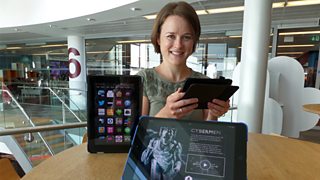
Anya Saunders
It was the latter challenge that faced the BBC when it began to focus on the growing market in e-books. How would its television programmes translate into this new medium? And should the BBC be developing e-books as a new platform for original content, either factual or fictional?
Anya Saunders was a producer on BBC Two’s Culture Show who, by her own admission, “hadn’t done anything techie in the past”. But last year she was appointed as lead producer on an e-books pilot and charged with steering six experimental products to fruition.
What Saunders brought to the project was experience in storytelling and a curiosity about what the new platform had to offer as a creative medium.
She also knew her way around BBC programme-making departments, understanding the pressures faced by the producers she’d need to persuade to help with her e-book experiment: “When you’re making TV shows you are always up against it.”
To make things happen, the e-books pilot needed “a lot of goodwill”, says Saunders. It was helpful for the project to keep a low profile: we’d been given a “licence to innovate”.
The first e-book was about D-Day, adapted from the television series D-Day: The Last Heroes produced by Tim Dunn. Initially available for iPad, it was later extended to Kindle and Android.
The BBC’s chosen e-book format is multimedia (rather than the text-only books that work on the original Kindles). There’s a mix of graphics, text and video - short clips of interviews, typically - which give an interactive experience, allowing the reader/viewer (what do you call them?) to choose how to navigate around the subject in a way that’s not possible on television - or even as easily in a book.
For producers, an e-book can make use of some of the good material that never made it into the final cut of the film. And while a film may get plenty of attention at the time of transmission, an e-book, like a dog, is for life (unless formats change so much it’s unplayable in a year or two).
The BBC’s second product, shipped in time for last Christmas, was a CBeebies Christmas Carol. By then the non-techie Saunders was writing confidently on the BBC Internet Blog about how it used “a GUI-based authoring tool with embedded HTML widgets allowing for a drag-and-drop capability”. For customers that simply meant “a magical digital storybook with pictures that come to life at the touch of your finger”.
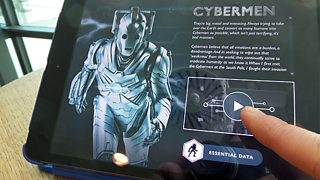
The Dr Who e-book
Most ambitious of all, organisationally at least, is an e-book collaboration with BBC Worldwide based on Dr Who. It’s free in the UK until 23July 2014 and costs $9.99 to download to tablets internationally.
So what has Saunders learnt about innovation? “We’re always being told to look for ‘the next big thing’,” she says, “but you’re not just going to stumble upon it.” To make real progress you need to focus in on something, and then experiment: “E-books were a good place to start because they’re simple, cheap and easy to produce, but they need text and video which are both things the BBC does very well.” But the end result “feels like something genuinely new”.
Anyone setting out on similarly innovative projects may want to heed Saunders’ conclusion that “something like this can only happen if you trial things and are not too worried.”
There are links to all the BBC e-books mentioned on the Dr Who page.
How should digital journalists mark the centenary of World War I in compelling new ways?
