UKIP’s new friends? Part 2: A guide to the anti-establishment parties in the new European Parliament

Sean Klein
is a media consultant and journalist and a former Brussels bureau chief for BBC News. Twitter: @BXLSeanK
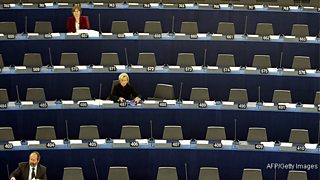
A quiet day at the European Parliament
Here I’ll profile the parties themselves (with the exception of UKIP, about which there is already plenty of information elsewhere on the BBC).
The top three anti-establishment parties in the new parliament are as follows (for details of the groups they belong to, see my previous post):
UKIP (UK): 24 MEPs (EFDD Group)
Front National (France): 23 MEPs (NI group)
5 Star Movement (Italy): 17 MEPs (EFDD)
Front National (France)
The party was formed in 1973 by the outspoken former French presidential candidate Jean-Marie Le Pen.
The FN is economically protectionist and socially conservative, with a strong - some might say extreme - nationalist core. On various occasions it has been accused of being anti-semitic, which UKIP says is the main reason it wants nothing to do with FN.
FN is Eurosceptic and against the euro, calling for France to withdraw from the common currency. Its policy on law and order is one of zero tolerance.
On immigration, while it no longer seems to support the repatriation of legal immigrants, it calls for illegal, criminal and unemployed immigrants to be sent back to their country of origin. Economically, the FN is protectionist and critical of globalisation.
In the NI Group, the Front National is particularly close to the Dutch PVV (Freedom Party) led by Geert Wilders.
Jean-Marie Le Pen's daughter, Marine, took over leadership of the party in 2011. In this year's European elections she led the FN to top the polls in France (25% compared to the Socialists’s 14%), causing what some have described as an earthquake in French politics. That has led to some serious soul-searching by President François Hollande and his party.
In recent days Jean-Marie Le Pen raised the political stakes when he made highly controversial comments about a French Jewish singer. He was criticised by his daughter, the party leader. And he hit back, accusing her of turning the party into a "conformist and insipid" version of the party he founded.
5 Star Movement (Italy)
This is an anti-establishment party that was officially launched in 2009 by the popular singer, comedian and blogger Beppe Grillo. It's been described variously as populist, environmentalist and anti-EU. Party members have tried to insist that the group is not so much a party as a movement. As such it is difficult to place it in the usual left/right spectrum.
The ‘five stars’ refer to the five themes with which the movement is primarily concerned: water, the environment, transport, development and digital connectivity.
Grillo came up with the idea of so-called V-Days (‘V’ being a combination of an obscene gesture and a victory sign) when thousands of supporters are encouraged to gather and sign petitions calling for changes to particular laws.
The movement gained more and more support until last year it won 25% of the vote in Italy’s general election. This year the movement did less well than expected in the European elections, but still has 17 MEPs after coming second in the May poll.
The movement supports so-called direct democracy, by which politicians are elected but act directly for the electorate rather than in parties. It also has a non-careerist attitude to politics, argues for greater transparency and supports gay marriage.
Other anti-establishment parties:
Alternative für Deutschland - AfD (Germany) (Now part of the ECR Parliamentary Group)
AfD was founded in 2013, largely on an anti-euro ticket. It describes the euro as a failed project but now says it is willing for Germany to keep the currency on condition that the less financially sound Eurozone countries leave. The party leadership has said it would be an 'act of kindness' to these countries if they were helped to exit the euro.
The party leadership includes senior German academics and has thus been dubbed the 'professors’ party'. It fought its first national election last September and scored just short of the 5% threshold needed to send legislators to the Bundestag. The BBC has described the AfD as the first Eurosceptic party in Germany for decades.
Its policies have an economic focus. They include: upholding the no-bailout clause of the Maastricht Treaty; allowing Eurozone countries to leave the euro and potentially to form separate currency unions; ending secondary market interventions by the European Central Bank; making the private sector bear the cost of bailouts; and letting member states decide which areas of law the EU should legislate on, with competencies repatriated if member states want. It opposes Turkey's accession to the EU and is also in favour of referenda in the Swiss fashion.
Lega Nord (Italy) - now one of the Non Aligned parties
The Lega Nord is a grouping of several regional parties in northern and central Italy. It’s a populist party campaigning to turn Italy into a federal state. It calls for more regional autonomy and has in the past called for independence for northern Italy (which it calls Padania). The party says it opposes a European super-state, preferring a "Europe of the regions".
The Independent reported that the leader of Lega Nord, Matteo Salvini, called the euro a "crime against humanity". Speaking at a party conference, he went on to say that the euro was "a criminal currency, a crime against business, against agriculture and against our entire economy”.
On immigration, the Lega Nord is stridently opposed to immigration from Muslim countries, but otherwise supports the promotion of immigration. As a result of this stance, critics have compared the party to the Front National, the Austrian Freedom Party and the Vlaams Belang in Belgium. In 2002 the European Commission against Racism and Intolerance (ECRI) denounced the party as xenophobic.
In the last European Parliament, the Lega Nord was part of the EFD, working with Britain's UKIP.
Podemos (Spain)
Podemos - meaning ‘We Can’ - was formed in March 2014 out of the Spanish popular political protest movement, the so-called indignados (‘the indignant ones’). It is led by Pablo Iglesias Turrión, a 35-year-old professor of political science in Madrid who says the left-wing Greek radical party Syriza is one of the inspirations for ‘Podemos’.
The party issued a policy document earlier this year which calls for a basic income for all, reducing poverty and restoring social dignity. It wants to withdraw from some free trade agreements and have referenda on any major constitutional changes. On the environment, it wants to reduce dependency on oil and big agribusiness and supports local food production.
Turrión has described the party’s European election result as disappointing, saying that the establishment Spanish parties won. He is also on record saying the party’s MEPs would take a salary considerably lower than the one on offer.
It remains to be seen to what extent the leaders of the establishment parties will be affected by these new forces in the European Parliament.
That will partly depend on how the fringe parties choose to engage with institutions that in many ways they fundamentally oppose.
