UKIP’s new friends? Part 1: A guide to the anti-establishment groupings in the new European Parliament

Sean Klein
is a media consultant and journalist and a former Brussels bureau chief for BBC News. Twitter: @BXLSeanK
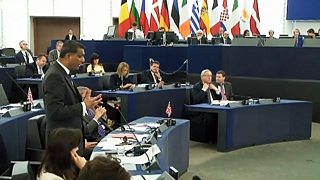
Tory MEP Syed Kamall addresses the European Parliament
About 13% of parliamentary seats are now split between what have become two what we might call anti-establishment (or ‘fringe’) groups:
- The EFDD (Europe of Freedom & Direct Democracy) has 48 seats (6.39%), with UKIP as is largest party.
- The NI (Non Attached) has 52 seats (6.92%) and is made up of MEPs who have not, under the rules, been able to form an official parliamentary Group. The largest among this collection of parties is France’s Front National; but it includes, among others, Belgium’s Vlaams Belang, Greece’s Golden Dawn, Hungary’s Jobbik, Netherlands’ PVV (Geert Wilders), and the UK’s DUP.
The parliamentary rules about what constitutes an official Group (as opposed to a group) are key to this discussion: to form a Group and thereby gain access to funding and the potential chairmanship of key committees, you need a minimum of 25 MEPs from a minimum of seven member states.
UKIP only managed to achieve this within EFDD after Italy’s 5-Star Movement changed its allegiance; and one of the members elected as a Front National member in France ‘defected’ from Marine Le Pen’s party to join the EFDD.
Meanwhile, even though the collection of parties which make up the so-called ‘Non-Attacheds’ (NIs) do indeed come from more than seven member states and are together in excess of 25 members, they were not able to agree a joint platform that would have formed a basis for a Group under the rules. This was clearly because they are very disparate politically, representing a broad spectrum that would never have been able to agree to work together.
The full collection of Groups (plus the NI, which is not, as explained, officially recognised) are now as follows (as at 1 July 2014):
EPP: 221
S&D: 191
ECR: 70
ALDE: 67
GUE/NGL: 52
GREENS: 50
EFDD: 48
NI: 52
ECR: European Conservatives and Reformists
This is the Group set up in the last Parliament by the UK Conservatives who, on David Cameron’s instructions, left the dominant EPP. As of this Parliament, the ECR includes Alternative für Deutschland, Germany’s new Eurosceptic party which is unpopular with Angela Merkel and her CDU party. This could be a bone of contention between Chancellor Merkel and David Cameron as he tries to win her over to support his quest for reform of the EU.
EFDD: Europe of Freedom & Direct Democracy (formerly EFD: Europe of Freedom & Democracy)
This Group contains UKIP’s 24 MEPs as well as 17 members from Italy’s 5 Star Movement (the group led by Italian comedian and blogger Beppe Grillo). Joining EFDD caused a lot of discontent among those who voted for 5 Star, as many are strongly left wing. EFDD also contains twos and threes from various other mainly small right-wing parties - including one ‘defector’ from Marine Le Pen’s Front National in France - making up a total of seven countries. The EFDD sees itself as what you might call the ‘respectable face’ of the right wing.
NI: Non-Attached Members
This is the grouping (not a Group) that largely includes (with some notable exceptions) right-wing and fringe groups, many of which are sympathetic to Marine Le Pen’s Front National.
Current make-up of NI:
23 - Front National, France
5 - Lega Nord (Italy) (In the last parliament they were members of EFD)
4 - PVV (Geert Wilders Party, NL)
4 - FPÖ, Austria (the right-wing Freedom Party)
4 - KNP, Poland (liberal, conservative Eurosceptics)
3 - Jobbik, Hungary (the right-wing anti-immigrant party)
3 - Golden Dawn, Greece (far right party)
2 - KNE, Greece (the Greek Communist Party)
1 - NPD, Germany (National Socialist)
1 - Die Partei, Germany (formed by writers on a satirical news magazine)
1 - Vlaams Belang, Belgium (the anti-immigration party)
1 - DUP, Northern Ireland
It’s clear that NI and EFDD - both ‘fringe’ blocs, one a formal parliamentary Group, one unofficial - won’t function together. But how they might operate, policy by policy, could be interesting and have an impact.
GUE/NGL
It’s worth noting that the GUE/NGL Group - with 52 members - could also not really be described as ‘establishment’ either. GUE/NGL includes Greece’s left-wing Syriza party and Spain’s new Podemos party, both of which want a major change to the system.
So much for the anti-establishment groupings. What about the main parties from which they are made up? In a second part, I’ll be looking at the anti-establishment parties themselves.
UKIP’s new friends? Part 2: A guide to the anti-establishment parties in the new European Parliament
