Why the launch of eBay was a media milestone

Charles Miller
edits this blog. Twitter: @chblm
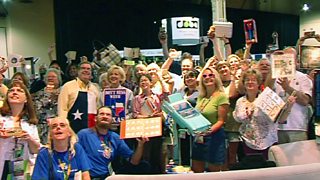
Sellers at the eBay Live convention in Las Vegas, 2006
Twenty years ago this week the first auction was listed on eBay. It was for a broken laser pointer belonging to the site’s founder, Pierre Omidyar. To his amazement it sold for $14. Nobody else noticed. But AuctionWeb, as it was then called, has never looked back.
1995 had already been quite a summer. In August the US stock market valued Netscape, the loss-making web browser company, at nearly $3 billion. And software became unignorable when Bill Gates turned his PR machine up to full volume for the launch of Windows 95. The Rolling Stones’ song Start Me Up, the Windows 95 launch theme, even brought Gates within range of looking cool.
With excitement about the internet peaking in Silicon Valley, it was the summer that the tech world we live in emerged into the West Coast sunshine - or, in Gates’ case, under the overcast skies of his home town, Seattle.
Three technologies were starting to overlap: telephones, television and computers. Today, every smartphone is a television and a computer. Every new television uses computer connections and technology, and every computer is also a telephone and a television. Mine was used as a television in the kitchen last night.

I don’t know how many people saw all this coming back in 1995, but the established media knew something was up. One of the best insider accounts of the dotcom boom, Michael Wolff’s Burn Rate, tells of Time-Warner’s attempts to create a website for the content from all its magazines. The site never made money or much impact but there was soon talk of it being spun off as a billion dollar business.
That was par for the course in those days. “It was like Hollywood in the teens or Detroit in the 1920s,” as Wolff put it. In the media world, the internet meant the chance to “produce and distribute content on some altogether new basis”.
Exactly what basis is still being worked out.
Whilst Netscape and the ‘browser wars’ and Microsoft’s efforts to put ‘a computer on every desk and in every home’ would appear more central to tech changes of the past twenty years, eBay is as relevant to changes in the media as any other development in 1995.
First, eBay undercut the newspapers’ classified advertising business. Instead of spending money with their local paper, sellers could reach a much larger audience online. They could use as many words as they liked to describe their items and show pictures too. A larger audience meant a better chance of finding that elusive buyer who’d pay for a broken laser pointer.
It wasn’t just the classifieds that suffered: ad revenues of all print media were hit by online competition as Yahoo! and other sites took money for banner ads, and then Google and others built their fortunes on targeted pay-per-click advertising models.
But there’s another way in which eBay set the stage for today’s media world. Omidyar had a brilliant idea to reassure people about the anonymity and potential riskiness of online shopping. He created a feedback system in which buyers and sellers would rate each other, leaving comments and awarding stars. The site would be a friendly, chatty place with messageboards where users could discuss buying and selling and much else besides. Omidyar himself posted messages and chatted with users.
It was a genuine community - or, as we’d call it, a social network. Facebook is eBay without the buying and selling. Social media has emerged as a direct rival to the world of traditional media, claiming its audience’s time with its own content – as well as that of its media rivals.
Look no further than a post on this blog earlier this week: Ian Carter, an executive of a regional newspaper group, complains that when they put their stories on Facebook, local papers get no credit from readers for their original reporting. He doesn’t mention the other problem: that his papers don’t get paid for the stories being read on Facebook.
So happy anniversary eBay. If some of the folksiness of your early days has been lost, the principles of do-it-yourself media where it’s the customers who create the content, plus the idea of drawing people into a community by letting them establish reputations online, both laid the foundations for our media world: so feel free to tweet, share or leave comments below.
