Ukrainian TV’s partisan coverage of conflict belies its bold new journalism

Andrey Kondratyev
is a senior journalist in BBC Monitoring's Kiev unit
In their coverage of the conflict in Ukraine’s turbulent east, the country’s major television channels are like a choir in which no performer sings out of tune.
There seems to be agreement about how Kremlin-backed rebels are referred to - mostly as 'terrorists' and sometimes 'bandits' - and Russia is often branded the 'aggressor'.
The flagship evening news bulletins, or at least their military segments, are similarly scripted and structured. Each contains a detailed update from the front line. Such dispatches are wide-ranging but one-sided, as the hostilities are presented only from the government’s perspective.
Ukrainian troops are commended as heroes - patriotic, fearless and iron-willed. They are even endowed with superhuman powers, as manifested in the nickname given to the defenders of Donetsk airport: the 'cyborgs'.
Reports shot at military hospitals showing severely wounded yet undefeated men are particularly poignant. So are those about the funerals of their comrades-in-arms killed in combat: red carnations interspersed with the yellow-and-blue of Ukrainian flags, and crowds of mourners on their knees to pay their last respects to the fallen.
The evening broadcasts also frequently tell the heart-breaking stories of civilians trapped in the conflict, be it a dazed octogenarian whose home has been shelled or a toddler weeping in an unlit basement during a bombardment.
Since the EU-brokered ceasefire agreement formally came into force on 15 February, the media have been prompt to report its numerous breaches. There has also been much speculation about whether the ‘insurgents’ will attempt to seize new territories, especially after the forced retreat of Ukrainian troops from the strategic town of Debaltseve.
Predictably, at the time the ceasefire deal was struck in Minsk, the television channels were unanimous in their reaction. It was a mix of cautious hope and (now justified) scepticism. “A ghost of peace” is how the popular One Plus One channel described the agreement.
The questioning caption “Peace near?” on the opposition-leaning Ukrayina TV reflected the uncertainty that prevailed following the Minsk talks. But while state-owned UT1 reported President Petro Poroshenko's remark that Ukraine had not surrendered any of its national interests, it led its news bulletin with former foreign minister Volodymyr Ohryzko's grim warning: "There are more mines than could have been imagined. And we all, both in Ukraine and in the West, can easily blow ourselves up on them."
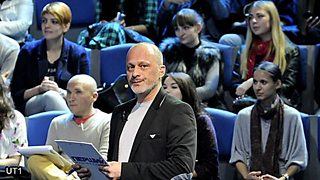
UT1’s choice to highlight the diplomat’s opinion, which questioned the viability of the accord negotiated by the president, is one of many illustrations of how the channel has been transforming under its new management. Facing major obstacles, among them insufficient funding and flawed legislation, a team led by Zurab Alasaniya (pictured above), a prominent journalist and media manager, is striving to turn UT1 into a fully fledged public broadcaster.
In less than a year it has rolled out more than a dozen new programmes, notably Schemes and Investigation Info. Both programmes have exposed dubious business practices and corruption in the highest echelons of government - a remarkable development for the channel which has toed the government line for years.
The satirical UT1 with Michael Shchur is one of the most popular new shows. Its anchor, who once described his style as "hoolijournalism", discusses the main events of the week in a tongue-in-cheek and slightly outrageous manner, mischievously ridiculing the country's senior politicians. In a recent episode he made fun of the prime minister, who was said to lack a sense of humour. Another edition mocked a pro-government law-maker's incoherence.
The news bulletins too have become more pluralistic, although all the political views remain clearly pro-Ukrainian. Despite Alasaniya’s assurances that UT1 would rigorously adhere to universally recognised editorial standards, it ignores the voice of the rebels.
He defends the decision not to give them the floor, saying: “Since a court ruled that they were terrorists, there is nothing to talk to them about - full stop.”
However, Alasaniya concedes that those who support the rebels without taking up arms should be able to express themselves freely on state television.
Ukrainian media staging own revolution in face of Russian ‘propaganda’
Are ratings driving Russian TV propaganda in Ukraine?
Our other blogs on Russian media coverage by regional analyst Stephen Ennis
Blogs by Sajid Iqbal, Urdu analyst at BBC Monitoring
Will al-Jazeera case shine new light on threat to Egyptian journalists?
The contrasting fortunes of three Arab Twitter users
