Are ratings driving Russian TV propaganda on Ukraine?

Stephen Ennis
is Russian media analyst for BBC Monitoring.
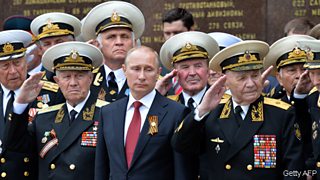
President Putin with veterans in the Crimean port of Sevastopol, May 2014
An article in Russian heavyweight broadsheet Nezavisimaya Gazeta on 15 October claimed to have detected a toning down of state TV's onslaught against Ukraine. It noted that terms such as "junta" (to describe the Kiev government) and "punitive operation" (to describe the activities of the Ukrainian military) were not being used as frequently as a month earlier.
But there was little sign of a milder approach in that evening's primetime bulletins which were full of talk about "fascists" in Kiev. The two main stations, Channel One and Rossiya 1, both quoted President Putin as saying that the "virus of Nazism is returning to Europe, especially in Ukraine and the Baltic States".
Since then, Russian TV's reports about events in Ukraine have got, if anything, even more lurid. On 2 November, Channel One ran a report alleging that Kiev government troops fighting Russian-backed insurgents in the east had been promised "land and two slaves". "Hitler made the same promise to his soldiers," the correspondent noted.
In fact, there has been no significant let-up in Russian TV's inflammatory coverage of Ukraine since pro-Russian President Viktor Yanukovych was removed from office in February.
All of Russia's main TV channels are in one way or another under the control of the Kremlin, and as such they faithfully serve its interests.
Back in March, a Russian hacker group called Anonymous International published a photograph of what appeared to be a set of instructions to TV stations on how to cover events in Ukraine. According to the document, the channels were enjoined to convey an "atmosphere of lawlessness and growing chaos [with] Nazis occupying top government posts [and] the economy spinning out of control". They were also told, it would seem, to promote the holiday season in the newly annexed territory of Crimea.
But, as the conflict has gone on and the propaganda campaign has reached new extremes, some observers have suggested that TV coverage has started dictating government policy rather than the other way around - a case of the tail wagging the dog. Among them is former Kremlin spin doctor Gleb Pavlovskiy who is now an outspoken critic of Putin and his policies.
In an interview with independent newspaper Novaya Gazeta in September, Pavlovskiy said that the "ultra-propaganda" of Russian TV is not so much a "loudspeaker broadcasting from Putin's office" as a "loudspeaker directed into it".
He also suggested that the TV channels had their own audience-driven agenda.
"Just as a politician cannot give up a high rating - it is a drug for him, so television will not give up a big audience - it is also like a drug," he said.
One of the most notorious episodes in the Ukraine propaganda war was a report aired by Russia's rating leader Channel One TV in July in which a woman refugee from Ukraine claimed to have seen Kiev troops crucifying a small boy in a town they had recently recaptured. The report was condemned internationally and in Russia as a gross falsehood, with even some pro-Kremlin media joining in the criticism.
But deputy communications minister Aleksey Volin saw nothing wrong with it. "It conformed to all the norms and rules of journalistic ethics," he told liberal TV station Dozhd. Volin went on to say that if a TV channel were to adopt a "more detached attitude to what is happening in Ukraine, viewers would not understand and it would fall in the ratings".
Viewing figures suggest Volin may have a point. The inflammatory coverage of Ukraine is certainly drawing large audiences. According to data from market researcher TNS, in the 27 weeks from 24 February (two days after Yanukovych's fall) to 7 September, a news bulletin or current affairs show was the week's most popular broadcast on all but five occasions.
In four of these weeks, the top broadcast (with the news second) was a major sports event: the football World Cup or the ice hockey world championships. On only one occasion were news bulletins outstripped by a regular entertainment show.
But that's not all. In 10 weeks, news and current affairs shows occupied the top two slots, and in a further nine they held two of the top three. Before the Ukraine crisis the top news and current affairs tended to come in third or fifth in the weekly ratings, according to TNS.
A similar picture emerges from looking at the performance of the state news channel Rossiya 24. In 2013, Rossiya 24's average audience share was 1.2%, making it Russia's 16th-most popular channel. But between 24 February and 7 September its average audience was just over 4% and it was never out of the top 10, according to TNS.
There are signs, though, that the Russian public's appetite for sensationalist coverage of Ukraine may be waning. In recent weeks, Rossiya 24's average audience has dipped below 3% and it has fallen out of the top 10. Meanwhile, over on the main channels, the weekly ratings have been led by the talent show the Voice and the Soviet-era drama the House with the Lilies.
Source: BBC Monitoring analysis
Our Russian website
