Why did you get into journalism and would you do it again? Part one

Cathy Loughran
is an editor of the BBC Academy blog
When he offered his no doubt well-meant advice to young, aspiring journalists last week - about journalism being a “dumb career move” in 2015, and likely to get dumber - financial writer Felix Salmon unleashed a bit of a backlash.
First out was Alex Thomson of Channel 4 News who railed against Salmon’s negativity, pressing instead the case that journalists whose work actually made a difference became journalists because they were “angry” at the status quo and wanted to make things better. No matter that there was almost certainly much more money to be made elsewhere, as Fusion senior editor Salmon had argued.
Next day a tub-thumping Roy Greenslade, writing in the Guardian, took up the baton, applauding Thomson’s passion for the principles, not the pounds, involved in serious journalism. Far from wanting to discourage the next generation of news hounds, Professor Greenslade planned to use the Channel 4 chief correspondent’s blog to further inspire his journalism students at City University.
A week on, feelings were still running high. Ezra Klein, editor of US media company Vox.com, was one of the voices loudly championing journalism as a career choice, not to say “dream job”, and offering his own “best advice to young journalists” as an antidote to Salmon.
There were of course one or two reality checks, including in a dedicated discussion on Twitter where some stats about PR people outnumbering journalists by nearly five to one, and out-earning them by 54%, gave even the passionate pause for thought. “Have rich parents” was another #AdvicetoyoungJournalists tip.
I thought I’d throw open the debate to a random but established pool of practitioners. Why did they get into journalism in the first place? And would they do it all again if they were starting out today? Here’s a sample of responses:
Robert Peston, economics editor, BBC News
I became a journalist by accident when trying out different ways of making a living. But I discovered very quickly there is no more exciting and fulfilling job in the world. What else would anyone want to do but be paid to learn about how the world works, meet fascinating people and communicate stuff that matters and sometimes changes lives?
I also regard this as the best time ever to be a journalist because we have so many more tools for researching and telling. In this digital age the whole world is ours to explore and engage with.
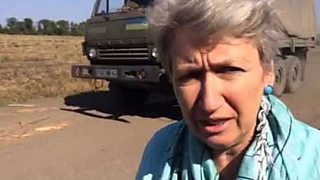
Lindsey Hilsum reporting on the conflict in Ukraine for Channel 4 News
Lindsey Hilsum, international editor, Channel 4 News
One day in 1986, when I was working for the UN Children's Fund in Kenya, rebels next door in Uganda reached the capital. Fighting erupted on the streets and the president fled. I couldn't stand not being there, so headed for the airport hoping the Unicef office in Kampala would find a use for me. It's the only time I've been paged on a tannoy: "Message for Lindsey Hilsum - come back, do NOT get on the plane."
I gave in, but a few days later had wangled a way of going to Uganda to assist a TV crew making a film about child soldiers. That was the moment I realised it was all over for me as an aid worker - I wanted to be journalist. I needed to be where history was happening.
I would never discourage young journalists, but I would say that it's better not to head for the most dangerous war zone at the beginning of your career. War is more dangerous for journalists now than it was when I started, especially if you have no organisation behind you.
I know that it's hard to make a living and these days you have to shoot, edit and report, whereas all I've ever done is read, write and talk, but I think if you have the urge you have to give it a go. Some of the best journalism these days is done not by news organisations but human rights and campaigning groups, and that can also be a good training ground.
My colleague Alex Thomson says anger motivated him. I was angry too: about injustice, cruelty and poverty. I still am. I feel it's important to expose the horrors we see, but easy answers get harder to come by. Something must be done - but I rarely know what.
Another motivation is nosiness. In what other career do you have the right to ask personal questions of a president one day and a peasant woman the next?
Would I do it again? Of course. After an unsuccessful career at the BBC, and several freelance stints, I was lucky enough to get a job with Channel 4 News. When I think of recent years - being in Tripoli as Gadaffi fell, driving into Gao with the Malian army as the jihadis fled, waking up in Crimea to discover that 'little green men' from Russia had taken over - I can't understand why anyone would want to do anything else.
Andrew Harding, BBC Africa correspondent
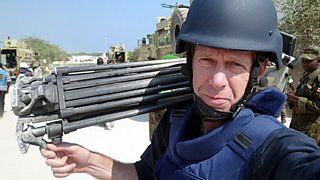
It was curiosity that sucked me into this trade. But more powerful impulses keep me here - in foreign news - and would make me do it all again, says Harding, pictured top reporting from Mogadishu.
Leaving aside the excitement; the buzz of being first to know something; of being in the right place at the right time; and the joy that comes from telling a good story… I’d say there were three driving factors:
- A strong belief that we have a duty to shine a light in dark corners. A famine in Somalia shames us all
- The knowledge that the worst sort of powerlessness is not having a voice. Journalism can correct that
- A growing sense that, in a world of increasingly contested, surplus, undigested information, the journalist’s role is more vital than ever.
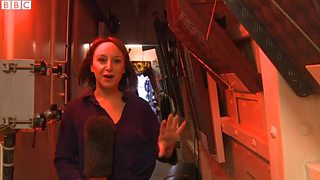
Anna Holligan reporting from a chemical weapons destroyer bound for Syria
Anna Holligan, BBC correspondent at The Hague
I was inspired by the film Cry Freedom. We watched it in modern studies class. I saw journalists as the purveyors of truth whose purpose it was to expose injustices in the world and provide a voice (or a platform) for the voiceless. Just like many others, I wanted to be a journalist because I wanted to make the world a better/better informed place. Simple.
It's disheartening to hear journalists discouraging young people from pursuing a career in this industry. I’ve broadcast from a chemical weapon-destroying ship bound for Syria, filmed in a Nato helicopter in the Arctic, and conducted interviews while riding with wild horses in Iceland.
We get paid to be curious and ask questions. Yes, this opportunity comes with great responsibility. I must dissect the complexities of international law, endure the occasional 24-hour day, and I'm conscious that every word I say may be scrutinised for accuracy. Would I do anything else? Not if I can help it.
We are expected to do more and more. I shoot, edit, report, produce and present. The demands can be intense, but I think now is an exciting time for young journalists. Twitter has democratised things. You can showcase your news-savvy abilities, and there is a desire for innovation that will help the BBC, for instance, to connect with new audiences. The opportunities are vast.
Philip Webster, assistant editor (politics), the Times
I had no high-minded motives for entering journalism back in the 1960s. I thought it would be more fun than most of the alternatives. In the decades since I have never regretted it. It has been huge fun, but thankfully it has proved to be a worthwhile choice.
We do an important job because there are people everywhere who wish we did not exist. If you know someone who hates journalists there is usually a reason - probably that a reporter has revealed something they would have liked to stay under wraps.
It's not the most socially useful job in the world. But it matters. And it is still fun. I never deter anyone who tells me they want to do it. You won't make a fortune but no-one going into journalism has ever expected that.
Justin Webb, Today presenter, BBC Radio 4
I went into journalism to travel and meet girls and present the Today programme. Bingo. Can young people still do that? Why not? Only worry would be the Today programme bit, but radio defies all predictions of decline. And John Humphrys will always be there.
I agree with Alex Thomson about the money: it must not and cannot be a motivating force. Though, as he says, you can make a perfectly good living. That said, if I had my time again I would be a professional rugby player…
Reporting business: Robert Peston
Reporting big numbers: Robert Peston and Mark Easton
Reporting foreign assignments: Andrew Harding
Live-tweeting a breaking news story: Andrew Harding
How to attend a press conference: Lindsey Hilsum
How to become a BBC journalist
Getting into journalism: Rory Bremner and DIY filming did it for Frank Gardner
Getting into journalism: Why radio was the right fit for Emma
Getting into journalism: Bring a different story - refugee Jamal Osman
Getting into journalism: Less doctor talk at the dinner table
Getting into journalism: Just go out and do it, says VICE maverick Tim Pool
