Reporting the migrant crisis: “What’s your name? What brought you here?”
Anna Holligan
is the BBC Hague correspondent. Twitter: @annaholligan
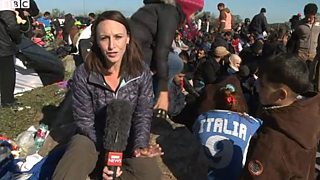
In part two of her blog, whose first part is here, Anna Holligan shares lessons about staying on top of Europe's migration story while finding time to reflect the experiences of individuals at its heart:
A typical day working on a top news story for the BBC starts with Breakfast and the Today programme and ends with the News at Ten or Newsnight. In between, most journalists are travelling, editing, sleeping or preparing for the next day of lives.
I remember deciding to spend a night camping out at Austria’s Nickelsdorf border crossing to show people what happens after the journalists normally go home.
We found a cardboard box and borrowed a blanket. It was our intention to sleep on the platform. But by the time we’d walked around speaking to refugees, volunteers and families still shaken by their sea-crossing, the sun was coming up, we had to edit a package and then it was time for our first live broadcast. There hadn’t been time to sleep.
When the people around you are bursting with stories it’s extremely difficult to stop recording. However hard, it’s important to try to set a deadline for rest - if you don’t get it, your reporting will eventually suffer.
That said, you need to be where the story is
The refugees were buffeted between Europe’s borders so rapidly it was hard to keep up. One afternoon in August we were following the refugee trail across Europe for BBC Radio 5 live. We arrived at Tovarnik camp on the Serbia-Croatia border to find thousands of people queuing for buses in the sweltering heat, families spilling over into residents’ back gardens.
As darkness fell, people started bedding down. By the time we returned to the same spot the next day, the refugees had vanished (as the contrasting tweeted pictures below reveal). When you’re in the field your job is to take the audience to the heart of the story: broadcasting with an empty backdrop jars.
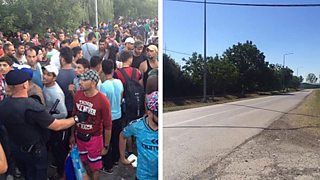
The lesson is to arrive extra early to give your team time to relocate if the story has moved on. And it always pays to exchange phone numbers with some of the refugees you interview, especially if they speak good English. Most of the Syrians we’ve met are on WhatsApp, so swapping numbers helped the immediate issue of keeping track of their movements but also allowed us to keep track of their journeys, ask for their insights and do follow-ups.
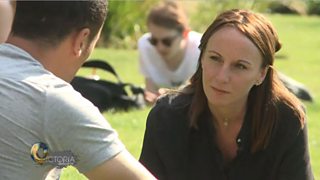
Like the story of this young Syrian man from Aleppo, whom we first met on Lesbos and, because we stayed in contact, agreed to let us catch up with him in Liverpool (below), after he’d managed to enter the UK.
But is this a story of ‘refugees’ or ‘migrants’?
These politically-charged terms became the subject of intense debate early on in the crisis. Some, including many of the refugees I met, thought the BBC was wrong to use the term ‘migrant’ which in their view ignored the fact that they were fleeing war.
In an interview he did in August, the BBC’s head of Newsgathering - Jonathan Munro - argued that the issue is less about labels and “more about the dehumanisation of people and the way we cover [the story]”.
Indeed, as Jonathan says, many of the people at the centre of this crisis are both migrants and refugees. Our job in the field is to take our audience beyond the numbers and the vocabulary, to talk to people and tell their stories.
Many people on Twitter have commented on the number of young men among the crowds, pointing out that “they're of fighting age”.
I stopped a group of men trundling down the railway tracks in Serbia. They told me they'd come from the Syrian city of Raqqa. They offered me raw carrots. I asked where their wives and mothers were. One man told me: “The women were murdered by Da’esh (Islamic State).” His son looked up at the sky and tears rolled down his cheeks.
Another father I met in Munich told me he was facing conscription into Assad's army. “I'm not a fighter,” he told me, “I’m a chef cook.” Everyone laughed at the absurdity.
You sometimes see people holding their hands up to obscure their faces from the cameras. Some have suggested they're jihadi fighters trying to hide their identities. I asked a few Syrian men why they didn’t want us to film them and they all gave the same explanation: they feared reprisals against their families left behind in Syria. They worried that if they were seen on TV their families would be blackmailed and they'd be forced to return to the war-ravaged place they used to call home.
Elsewhere, I came across Afghan children who'd been trained to tell foreigners they were Syrian. (Syrians often got a better place to sleep or were fast-tracked through the system). And there was a Pakistani man I met on the outskirts of Budapest who was posing as a Syrian woman's husband. He was caught out when he pronounced Damascus “Dimiskus” - and she scolded him in English.
What these people share is a desire for a better life. And just like us, they all have unique histories and motivations. Blanket terms can sometimes dehumanise them. It is important for those thousands on the move and for our audiences that we give as complete picture as possible, to help people understand the story.
I always start with the basics: “What's your name?…What brought you here?”
In part one of this blog: when professional and personal pressures collide.
Our other blogs by Anna Holligan
Our section on filming and recording, including smartphone journalism
Our section on social media skills
