Reporting the migrant crisis: Too many stories, too little time

Anna Holligan
is the BBC Hague correspondent. Twitter: @annaholligan
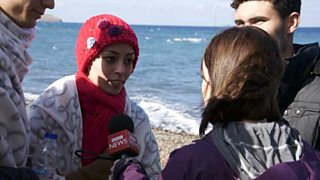
Anna interviews Afghan refugee Mahdia Ali on the shores of Lesbos
A chilling breeze swirls around the shores of Lesbos. I was first sent here to report on a surge in refugees arriving on the island’s rocky beaches last July - before most of us were aware of the looming crisis about to engulf the continent. Over the past four months I’ve been covering the refugee story for BBC News in Greece, Serbia, Croatia, Hungary, Austria and Germany.
The attacks in Paris and the possibility that terrorists are using refugee routes into Europe have added a whole new dimension to the migration story. But as winter approaches, there is little sign that the numbers crossing continents are decreasing.
In this two-part blog, I want to share some of the challenges my colleagues and I have faced and the techniques we’ve used to bring this relentlessly evolving story from the refugee trail to your smartphones, laptops and, for those who’re still watching, TVs.
Firstly, the practicalities: don’t run out of juice
A multitude of social media tools have made it easier than ever to share news. The constant drive to create and disseminate material can drain not just your time but your battery life. You may have seen photos of refugees hijacking electricity boxes inside the Kara Tepe camp. Greenpeace set up a solar charging tent in Roszke on the Hungarian border. The point is, charging points are hard to come by.
If you’re planning to use your smartphone for live radio two-ways, tweeting, periscoping, recording and sending radio reports and photos, or copy for the BBC News website, you must have at least one extra battery pack at your disposal. I use a phone case with an integrated battery charger and a mobile USB charger pack. They’re expensive but worth investing in. If you’re at a refugee camp when an impromptu protest breaks out and there are no other cameras there, you’ll be kicking yourself if you forget to carry that extra charger. I know I was.
Crossing the line
As journalists we try to be passive observers, our presence should never change the course of events. But I’ve experienced at least one case where, I admit, human instinct kicked in.
Hundreds of people have died trying to cross the Aegean Sea. We were filming one overcrowded dinghy as it careered into rocks close to the Lesbos shore. As the people scrambled out, one young Afghan man (pictured below) gashed his thigh. Blood was oozing from an open wound. Thanks to the BBC’s Hostile Environments and First Aid (HEFAT) course I was able to help tie a tourniquet. But the British volunteers we’d been filming were afraid to give him a lift, as in the preceding days locals had been arrested and accused of ‘people smuggling’ for carrying refugees in their cars.
As Hassan lay by the kerb, I remembered the late photojournalist Tim Hetherington’s fatal shrapnel wound. We lined our back seats with emergency foil blankets and set off towards the hospital.
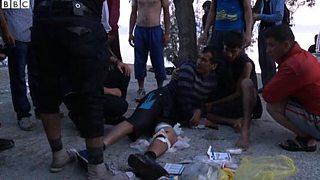
Shortly after, cameraman Harold Morris and I filed our film to BBC New Broadcasting House in London. Editor Jonathan Paterson called back. He understood why we’d taken the wounded refugee to hospital. But given that - by the time we’d arrived - Hassan seemed in fine spirits, our completed piece looked as though we had crossed the line. So we chopped our intervention out and the BBC broadcast this version of the story.
When you are immersed in reporting what’s happening around you, and inevitably ‘living the story’, it’s valuable to talk things though with an editor, one step removed, who can offer a more nuanced perspective.
Intimacy versus reality
We were asked to film a perfectly valid, potentially valuable piece about what the refugees carry in their backpacks. We sat down in the shade of a tree with a family from Aleppo. An exhausted mother pulled out some wet clothes – shaking her head, ashamed by the stench.
Her husband told us they didn’t pack anything precious because they knew that everything held dear could be lost at sea. All they carried were their academic and professional certificates, now drying out in the sunshine next to their children, who were colouring-in contentedly on the grassy verge.
Other networks and newspapers have since done this ‘treatment’ to great effect. But when you’re committed to servicing multiple platforms and must be in position for lives every hour, it doesn’t give sufficient time to speak to as many people as necessary to find the few who did bring something poignant or treasured. The majority of the refugees carry only essentials, there’s little time for sentimentality when you’re fleeing for your life.
This is the reality of this refugee crisis: there is never enough time to tell all the stories you come across. You have to trust your journalistic judgment and sometimes, human instinct. If you have to push too hard to make a piece work, think about why that might be, and be ready to adapt and move on.
In part two of this blog - staying with the story while following individual lives.
Our other blogs by Anna Holligan
Our section on filming and recording, including smartphone journalism
Our section on social media skills
